
Each Christmas we dream of the next generation of electronic gadget, the one that gives consummate satisfaction and delight. Then, the gadget in hand, disappointment creeps in, satisfaction dissipates. The gurus of Silicon Valley assure us that the ultimate experience is at hand, just a few more improvements and the right apps, and devices of virtual reality will be ….well, reality.
But there is a conundrum, no one seems to know what ‘killer apps’ will most engage the consumer.
Writing in the New York Times, Nick Wingfield* says,
Still unsettled is the question of which experiences will be most compelling. Like many people who have gotten a taste of virtual reality, Ben Schachter, an analyst who follows the game industry at Macquarie Securities, is bullish on the technology. Yet when asked to name a compelling application for it, he struggled. “I haven’t seen that one thing that makes you want to stay in there for hours,” Mr. Schachter said. “I’m frustrated I haven’t seen it yet.”
A lot of creative people are working to figure out what will be the most compelling virtual reality apps, whether games or movies.
‘Whether games or movies’? There’s the problem, I think neither. I do think that the efforts of the Times to create ‘virtual reality’ experiences as immersive news stories will be fruitful, and as claimed will enhance the experience of the consumer. But I think only incrementally.
So what does have the potential to provide transformative virtual reality experiences? The answer is far more simple than you might expect. It can be summed up in one word, conversation. Conversation in which the virtual person across from us (or next to us), not only responds to our words and language, but to our emotions, our facial and body language. Conversations that are deep and open-ended. This is not so far fetched.
The 17 July 2015 issue of Science was devoted to the topic of artificial intelligence. If you have access to Science take a look at the photograph on page 248 and the article by John Bohannon, “The Synthetic Therapist”(pp. 250-251).
Imagine now the rate at which the technologies surrounding artificial intelligence are evolving. We are rapidly approaching the satisfaction of the ‘Turing test’, in which the responses of a computer (to a human subject’s questions) are indistinguishable from the responses of a real person. Superimpose on that the technology of facial expression interpretation and a deep database and suitable algorithms for synthesizing responses based on the totality of the recorded writings and digital records of the person with whom you might wish to have a conversation.
We are not there yet, but the trajectory seems to be taking us in this direction. While almost certainly never able to match the warmth of real conversations, there are ways in which these virtual conversations could be compelling. Imagine a conversation in which the avatar has access to the sum total of human knowledge; the ability to deeply respond to every question. Imagine the people with whom you might have conversations, perhaps Maya Angelou, Susan Sontag, Sophocles, Mark Twain, Oscar Wilde, Jane Austen.
I sometimes create a visual work to express my thoughts about a topic. The photographs included with this post are two versions of the idea of the virtual conversation. The imagined subject is Philip Seymour Hoffman, who died tragically of a heroin overdose. So much left unsaid; what would further conversations reveal?
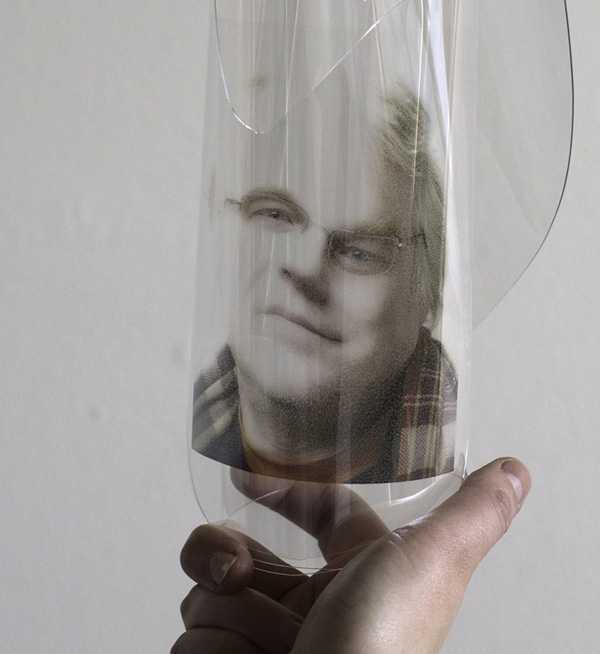
The Ghost in the Machine-I, projected image, 2015
Artist Statement
I know how we may talk with the dead. As a visionary, a scientist with deep understanding of the flow of science and technology I imagine what may come to pass. Among these visions are ideas about the ghost in the machine. I envision the confluence of information, data, code, and machine, enabling a new kind of existence. Recombination of fragments of virtual evidence from the cloud, like DNA from the past will enable the re-creation of virtual embodiments of the most engaging of deceased humans. Influenced by Hamlet’s conversation with the skull of Yorick and Gregory Crewdson’s staged scenes that reflect themes of isolation and loneliness, in longing for connection, I envision the technology of intimate encounters with incorporeal existences.
As an artist I give physicality to these visions, imbued with hints of what may not be quite right, warpages with unseen capacities to evolve into that which we may not want to see, conversations that we may not want to have. The work is expressed through projected digital images of the envisioned encounters.
Note: The work is constituted as a digital image projected onto a white wall. The height of the image should be at least six feet with the bottom of the image located three feet above the floor.
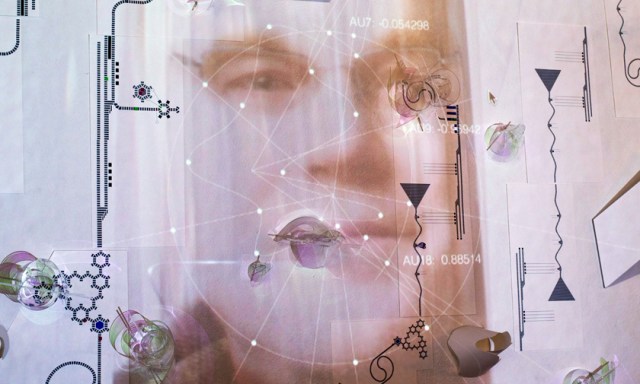
Ghost in the Machine – II, 2015, projected image
 AgainstEdges