A Simple Gift

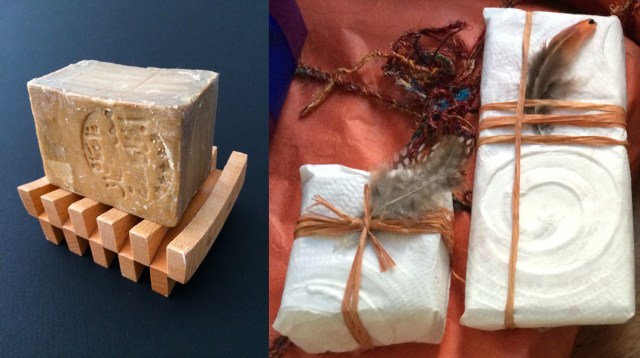
Aleppo soap

A Gift of Soap

From the earth
a simple gift
wrapped in paper
made by hand

no bow
just a feather
in remembrance

soap from laurel
from Aleppo
to wash away tears

shower drops
cascade onto tile
carrying fragments
of us

to the sea

an ocean beach
a small boy
face in the sand

returned to earth


The Best Gifts are the Ones You Make

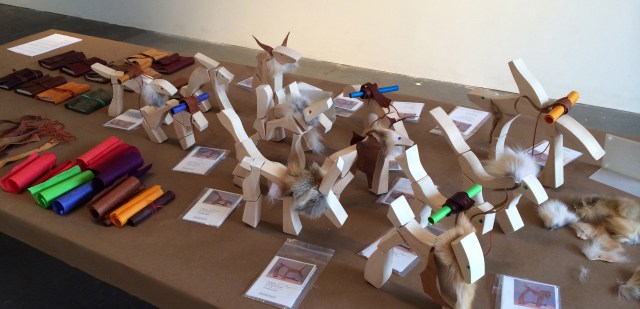
I think perhaps the best Christmas gifts of the past few years were the creatures that I made from blocks of Port Orford Cedar. I cut the wood and sanded each piece by hand; although well made, they were also just sufficiently flawed that they could not be mistaken for a mass produced toy. Of the twenty-five made, no two were alike. The creatures could be disassembled and reassembled in many different ways.

Creature March-0981

Wood block creatures

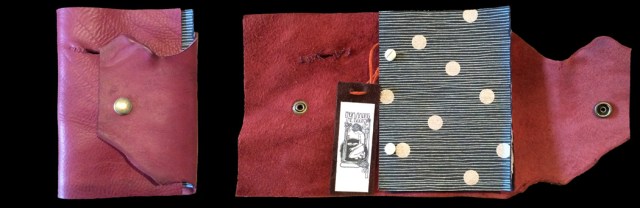
Each was accompanied by a blank journal through which a child could share their thoughts with the creature. The journals were unusual; made of scrap leather, most had imperfections that needed to be repaired by stitching. And yet there was something about them; like the creatures they were mysteriously endearing despite their flaws.

Wood block creature with scroll; Jennie writing in accompanying journal

I will make something different next year; I’m not certain what, but fortunately I needn’t worry; what ever it wants to be, will let me know in time.

Leather_0975Composite.jpg Leather bound journal


Instructions accompanying each wood block creature          

Your creature is completely unique; although it may resemble a familiar animal, it does not actually represent any known animal. Use your imagination to create a myth about its origin and history. We only know that at one time it was part of a living ecosystem in Southwest Oregon.

First steps:

  1. Name your creature: write the name just below its picture on the included 4 x 5 ¾ inch note card, and place the card in your journal.
  2. Take your creature completely apart and, using the picture as a guide, reassemble.
  3. Try putting your creature together in different ways.
  4. Keep a journal in which you can create stories about yourself and your creature.

A bedtime routine (a guide for parents):

Shortly before bedtime sit with your child and ask them what they have done today. Encourage them to talk about the best and worst experiences of the day.   Ask your child to spend a few minutes writing on a page from their journal about their experiences of the day.   If your child is too young to write, then write for them. To share your experiences with your creature, wrap the page in a piece of scroll paper (included) and leather cape (included) and place on the back of the creature overnight. Transfer the page to your journal (optional) in the morning.

Visual memory game:

A set of block pieces can be assembled in many different sequences and patterns. Two players can take turns assembling the blocks in a distinct pattern, then disassembling the pattern and challenging the second player to reassemble the blocks in exactly the same way. This works well in conjunction with a smart phone camera to record each pattern before disassembly. Start with just a few pieces and gradually work up to all the pieces for your creature (this can be challenging, even for adults).

Care of your wood block creature:

The wood is untreated and will accumulate marks from play over time. These can be removed by light sanding with fine sandpaper (150 to 220 grit). Alternatively you can protect your wood blocks by coating them with common floor wax or cutting block oil. However, if you do this you will lose the smell of the natural wood.

Parts:

6 to 8 Port Orford cedar blocks
¼” diameter polyethylene connectors
leather cape and scroll paper
leather journal


The Gift of (virtual) Conversation

Each Christmas we dream of the next generation of electronic gadget, the one that gives consummate satisfaction and delight. Then, the gadget in hand, disappointment creeps in, satisfaction dissipates. The gurus of Silicon Valley assure us that the ultimate experience is at hand, just a few more improvements and the right apps, and devices of virtual reality will be ….well, reality.

But there is a conundrum, no one seems to know what ‘killer apps’ will most engage the consumer.

Writing in the New York Times, Nick Wingfield* says,

Still unsettled is the question of which experiences will be most compelling. Like many people who have gotten a taste of virtual reality, Ben Schachter, an analyst who follows the game industry at Macquarie Securities, is bullish on the technology. Yet when asked to name a compelling application for it, he struggled. “I haven’t seen that one thing that makes you want to stay in there for hours,” Mr. Schachter said. “I’m frustrated I haven’t seen it yet.” 

A lot of creative people are working to figure out what will be the most compelling virtual reality apps, whether games or movies.

‘Whether games or movies’? There’s the problem, I think neither. I do think that the efforts of the Times to create ‘virtual reality’ experiences as immersive news stories will be fruitful, and as claimed will enhance the experience of the consumer. But I think only incrementally.

So what does have the potential to provide transformative virtual reality experiences? The answer is far more simple than you might expect. It can be summed up in one word, conversation.   Conversation in which the virtual person across from us (or next to us), not only responds to our words and language, but to our emotions, our facial and body language. Conversations that are deep and open-ended. This is not so far fetched.

The 17 July 2015 issue of Science was devoted to the topic of artificial intelligence. If you have access to Science take a look at the photograph on page 248 and the article by John Bohannon, “The Synthetic Therapist”(pp. 250-251).

Imagine now the rate at which the technologies surrounding artificial intelligence are evolving. We are rapidly approaching the satisfaction of the ‘Turing test’, in which the responses of a computer (to a human subject’s questions) are indistinguishable from the responses of a real person. Superimpose on that the technology of facial expression interpretation and a deep database and suitable algorithms for synthesizing responses based on the totality of the recorded writings and digital records of the person with whom you might wish to have a conversation.

We are not there yet, but the trajectory seems to be taking us in this direction. While almost certainly never able to match the warmth of real conversations, there are ways in which these virtual conversations could be compelling. Imagine a conversation in which the avatar has access to the sum total of human knowledge; the ability to deeply respond to every question. Imagine the people with whom you might have conversations, perhaps Maya Angelou, Susan Sontag, Sophocles, Mark Twain, Oscar Wilde, Jane Austen.

I sometimes create a visual work to express my thoughts about a topic. The photographs included with this post are two versions of the idea of the virtual conversation. The imagined subject is Philip Seymour Hoffman, who died tragically of a heroin overdose.   So much left unsaid; what would further conversations reveal?
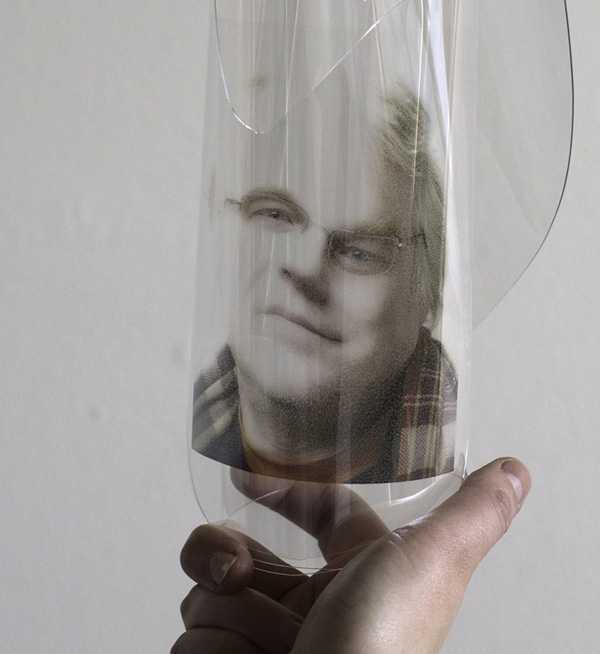
Hoffman-Nov12

The Ghost in the Machine-I, projected image, 2015

Artist Statement

I know how we may talk with the dead. As a visionary, a scientist with deep understanding of the flow of science and technology I imagine what may come to pass. Among these visions are ideas about the ghost in the machine. I envision the confluence of information, data, code, and machine, enabling a new kind of existence. Recombination of fragments of virtual evidence from the cloud, like DNA from the past will enable the re-creation of virtual embodiments of the most engaging of deceased humans.   Influenced by Hamlet’s conversation with the skull of Yorick and Gregory Crewdson’s staged scenes that reflect themes of isolation and loneliness, in longing for connection, I envision the technology of intimate encounters with incorporeal existences.

As an artist I give physicality to these visions, imbued with hints of what may not be quite right, warpages with unseen capacities to evolve into that which we may not want to see, conversations that we may not want to have. The work is expressed through projected digital images of the envisioned encounters.

Note: The work is constituted as a digital image projected onto a white wall.   The height of the image should be at least six feet with the bottom of the image located three feet above the floor.
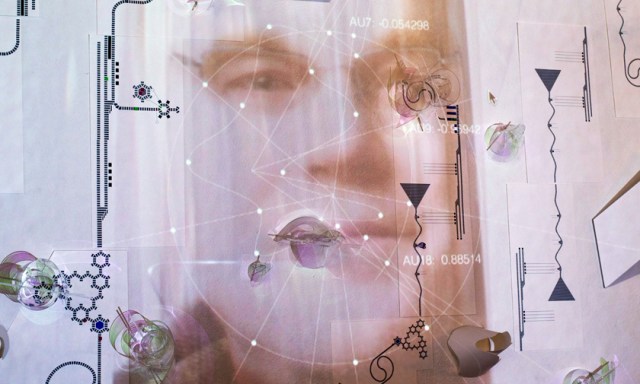
 

GhostinMachine45-2

Ghost in the Machine – II, 2015, projected image

The Riches of Christmas


JessicaHelgerson

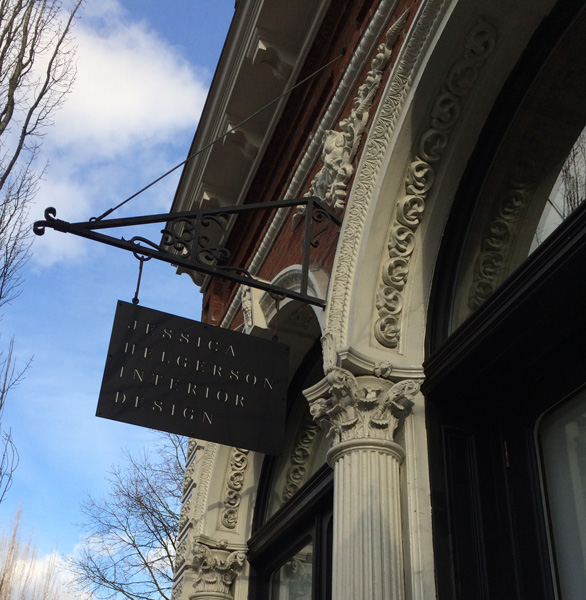
Jessica Helgerson Interior Design, Portland, Oregon

Christmas still feels like a magic time. Christmas music, decorations, and lights that surround us are catalysts for memories from childhood. The trip to the foothills of the cascades to harvest a tree, time spent around the dinner table with family, the warmth of home bring into focus that which is most important to us. The approach to crescendo occurs in the delight of children scrambling about the Christmas tree searching for presents tagged with their names.

Then there are the gifts that come in the form of unanticipated encounters; encounters with mysterious objects that peak curiosity while defying explanation.


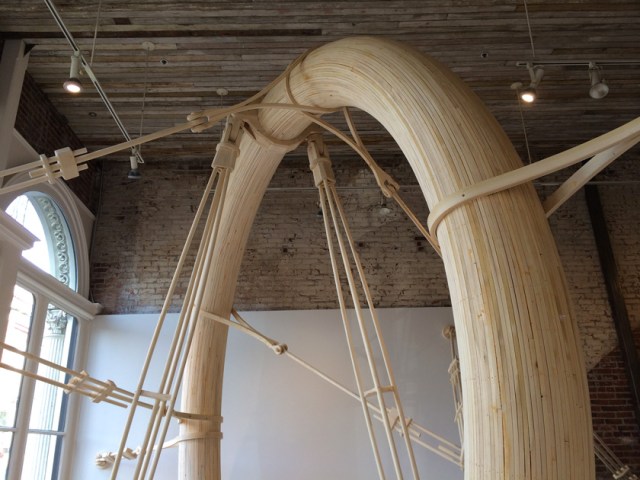
RathbunWorkNov2015-2

Mike Rathbun, I Have Love in my Heart as a Thief has Riches

The form of the encounter was a sculpture installed inside the Jessica Helgerson Interior Design Studio in downtown Portland. The work by Mike Rathbun, titled I Have Love in my Heart as a Thief Has Riches,  is an exquisitely crafted wood structure (see posted photographs). The work is open to a wealth of interpretations, yet there was one association in which I became entrapped. The building’s classical façade, with Corinthian columns evoke ancient civilizations. The sculpture, which stands just inside the door, somehow evoked, and then immersed me in the journey of Odysseus; lost at sea, seeking, tenuous moorings, the longing for home and connection.

The work is simply astonishingly beautiful; difficult to say more. One needs to experience it in person. Jessica Helgerson Interior Design is located at 112 SW First Avenue, Portland, OR.


Rathbun_2726