
The landscape of my childhood was the barren hills of Eastern Oregon, cowboy culture, the Native Americans of the Umatilla tribe, the Blue Mountains, Columbia and Snake Rivers, the route of Lewis and Clark, of Sacajawea. As a young child, in play and in craft, I led an imaginary life that bridged the borderlands between cowboy and Native American culture. On Saturday morning I would harvest scrap leather from the bins at Hamley & Co, makers of saddles, belts, cowboy gear. Objects that I fashioned from these scraps functioned as props for imaginary role-playing.
The gathering of the tribes at roundup time, the ceremony and pageantry of Happy Canyon, these were the foundations of my interests and impressions of the mystic of the native American, celebrating the eternal cycle of nature while living in and with the land. Even at a young age I was well aware that the ethos of western culture founded on principles of conquest and acquisition had created the 20th century pathos of the First People’s of the Americas.
In those years the meat in our diet was elk and deer, harvested by rifle in the fall, which we stored frozen through the winter. Thanksgiving and Christmas meals were celebrated with Pheasant. Animal skins, leather, wool; these are the materials of my childhood that I most fondly recollect.
Years later these materials continue to engage my imagination.
I hadn’t expected to take Experimental Fashion, was not even aware that the course was available. When I heard Lauren, Phoneix , and Will discussing the first class, I knew I had to be there. I was able to register late. Having missed the first class, I did not know what to expect. At the second class-meeting when I learned that the first assignment was to create an outfit that exemplified concepts of camouflage, I knew exactly what I needed to do.
Jennie was game.
She loved the outdoors and animals, especially goats and sheep, as one would expect of all seven year olds.
I set out immediately in search of material in the scrape bins, counters, tables and shelves at Oregon Leather Co.; like Hamley & Co. years earlier, within walking distance of my home.
In late January, early February I constructed the prototype of a cloak, prescient of themes on display in New York throughout Spring and Fall.* In the absence of runway, in preference for field and the company of goats, I layered goat hide on pigskin, a match blessed by the Chinese zodiac, sewn with deerskin lace, and linen thread, clasped by bone. This was an outfit destined for assimilation into the lives of animals.
The outfit completed, Jennie and I went in search of a herd of goats.

Cooper was the most curious, he followed Jennie as she moved throughout the enclosed field and into the trees. Atho and his sister Winter came up to chew on her cloak, but after a while lost interest. Others among the herd seemed to take no notice at all.
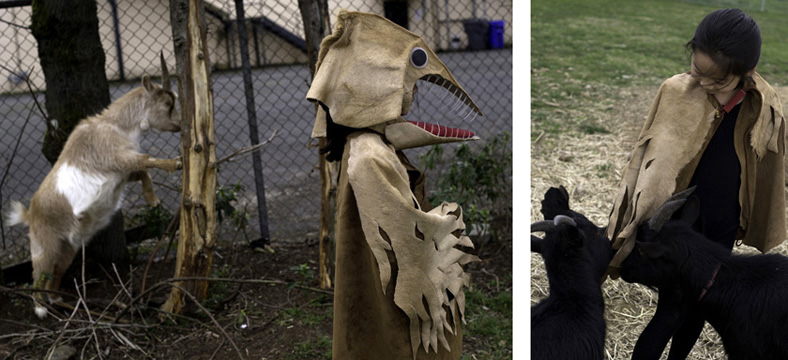
Jennie was relieved to finally remove her headpiece; only then was she comfortable with the herd.
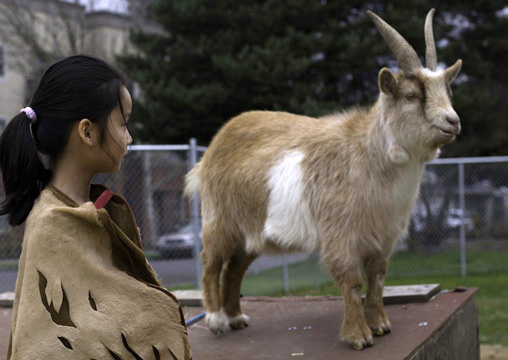
In retrospect, the photographic images seem more eventful than the actual encounters.
Next time perhaps we should bring food.
*Sunday Styles, New York Times, September 27, 2015. Last winter I began to follow fashion in the New York Times. I love the insightful writing of Vanessa Friedman, but oddly enough also find myself contemplating fashion ads. The full page Ralph Lauren ad on p. 5 brought back images of early childhood, layered with meaning that captures longings for the pastoral and the imagined cultures of Native America; semblances of elegant primitivism; leather belt and shoes, cashmere sweeter layered above a long cashmere skirt underneath a sumptuous shearling collar that extends from waist to broad brim hat. Fur pelts lie on the surrounding benches; a Siberian husky, indistinguishable from wolf sits awaiting command directly in front, another lies at the models feet; massive antlers stand on floor in line with the partially bark stripped poles projecting upward to the peak of an imaginary tepee. The coordinated creative efforts by fashion designers, fabricators, animal trainers, photographers, set designers, on this imaginary world of desire personifies our western culture of acquisition and appropriation.
Earlier in the year Vanessa Friedman wrote of “… Canadian fox minifrocks and feral coats pieced together like the earth as seen from above.” In the words of Raf Simons of Christian Dior, this is the “ … the terrain of the ‘femme animal’” ; a “new kind of camouflage”.
The sense of ‘new’ is only in the sensorial migration from the wild landscape of the west to the fabrication of the runway; the image of George Carlin’s, painting, Buffalo Hunt under the Wolf-skin Mask from the 1830’s flashes through my mind.
There is no edge to the imagination.
 AgainstEdges