The Best Gifts are the Ones You Make

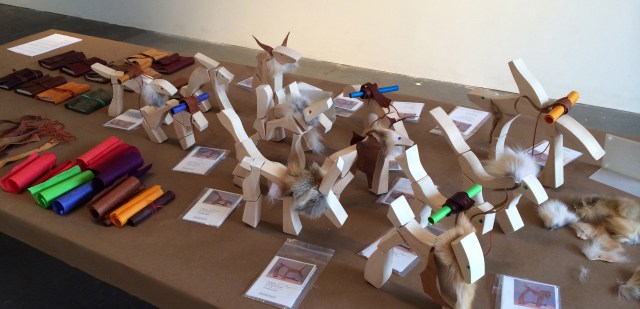
I think perhaps the best Christmas gifts of the past few years were the creatures that I made from blocks of Port Orford Cedar. I cut the wood and sanded each piece by hand; although well made, they were also just sufficiently flawed that they could not be mistaken for a mass produced toy. Of the twenty-five made, no two were alike. The creatures could be disassembled and reassembled in many different ways.
Creature March-0981

Wood block creatures

Each was accompanied by a blank journal through which a child could share their thoughts with the creature. The journals were unusual; made of scrap leather, most had imperfections that needed to be repaired by stitching. And yet there was something about them; like the creatures they were mysteriously endearing despite their flaws.

Wood block creature with scroll; Jennie writing in accompanying journal

I will make something different next year; I’m not certain what, but fortunately I needn’t worry; what ever it wants to be, will let me know in time.
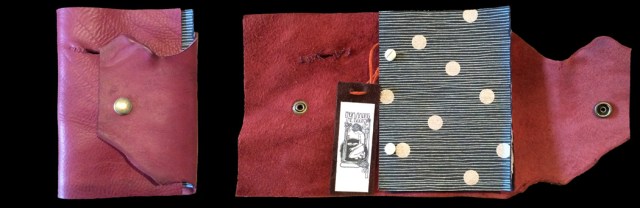
Leather_0975Composite.jpg Leather bound journal


Instructions accompanying each wood block creature          

Your creature is completely unique; although it may resemble a familiar animal, it does not actually represent any known animal. Use your imagination to create a myth about its origin and history. We only know that at one time it was part of a living ecosystem in Southwest Oregon.

First steps:

  1. Name your creature: write the name just below its picture on the included 4 x 5 ¾ inch note card, and place the card in your journal.
  2. Take your creature completely apart and, using the picture as a guide, reassemble.
  3. Try putting your creature together in different ways.
  4. Keep a journal in which you can create stories about yourself and your creature.

A bedtime routine (a guide for parents):

Shortly before bedtime sit with your child and ask them what they have done today. Encourage them to talk about the best and worst experiences of the day.   Ask your child to spend a few minutes writing on a page from their journal about their experiences of the day.   If your child is too young to write, then write for them. To share your experiences with your creature, wrap the page in a piece of scroll paper (included) and leather cape (included) and place on the back of the creature overnight. Transfer the page to your journal (optional) in the morning.

Visual memory game:

A set of block pieces can be assembled in many different sequences and patterns. Two players can take turns assembling the blocks in a distinct pattern, then disassembling the pattern and challenging the second player to reassemble the blocks in exactly the same way. This works well in conjunction with a smart phone camera to record each pattern before disassembly. Start with just a few pieces and gradually work up to all the pieces for your creature (this can be challenging, even for adults).

Care of your wood block creature:

The wood is untreated and will accumulate marks from play over time. These can be removed by light sanding with fine sandpaper (150 to 220 grit). Alternatively you can protect your wood blocks by coating them with common floor wax or cutting block oil. However, if you do this you will lose the smell of the natural wood.

Parts:

6 to 8 Port Orford cedar blocks
¼” diameter polyethylene connectors
leather cape and scroll paper
leather journal



Imagining the Pastoral – Part 2

The landscape of my childhood was the barren hills of Eastern Oregon, cowboy culture, the Native Americans of the Umatilla tribe, the Blue Mountains, Columbia and Snake Rivers, the route of Lewis and Clark, of Sacajawea. As a young child, in play and in craft, I led an imaginary life that bridged the borderlands between cowboy and Native American culture. On Saturday morning I would harvest scrap leather from the bins at Hamley & Co, makers of saddles, belts, cowboy gear. Objects that I fashioned from these scraps functioned as props for imaginary role-playing.

The gathering of the tribes at roundup time, the ceremony and pageantry of Happy Canyon, these were the foundations of my interests and impressions of the mystic of the native American, celebrating the eternal cycle of nature while living in and with the land. Even at a young age I was well aware that the ethos of western culture founded on principles of conquest and acquisition had created the 20th century pathos of the First People’s of the Americas.

In those years the meat in our diet was elk and deer, harvested by rifle in the fall, which we stored frozen through the winter. Thanksgiving and Christmas meals were celebrated with Pheasant. Animal skins, leather, wool; these are the materials of my childhood that I most fondly recollect.

Years later these materials continue to engage my imagination.

I hadn’t expected to take Experimental Fashion, was not even aware that the course was available. When I heard Lauren, Phoneix , and Will discussing the first class, I knew I had to be there.  I was able to register late. Having missed the first class, I did not know what to expect. At the second class-meeting when I learned that the first assignment was to create an outfit that exemplified concepts of camouflage, I knew exactly what I needed to do.

Jennie was game.

She loved the outdoors and animals, especially goats and sheep, as one would expect of all seven year olds.

I set out immediately in search of material in the scrape bins, counters, tables and shelves at Oregon Leather Co.; like Hamley & Co. years earlier, within walking distance of my home.


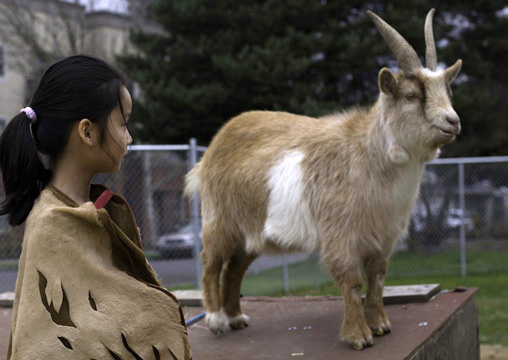
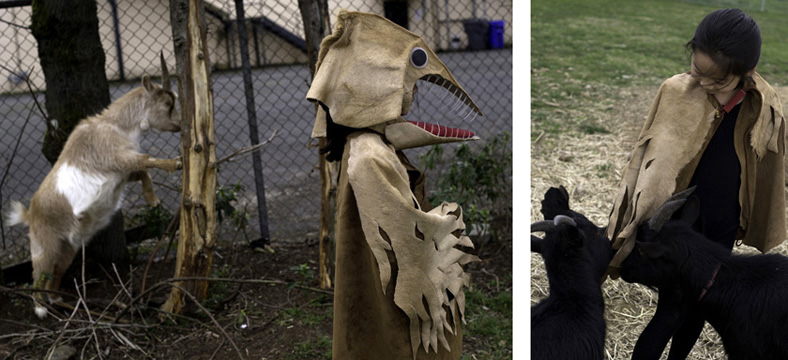
In late January, early February I constructed the prototype of a cloak, prescient of themes on display in New York throughout Spring and Fall.*   In the absence of runway, in preference for field and the company of goats, I layered goat hide on pigskin, a match blessed by the Chinese zodiac, sewn with deerskin lace, and linen thread, clasped by bone. This was an outfit destined for assimilation into the lives of animals.

The outfit completed, Jennie and I went in search of a herd of goats.

EyeingEachOther

Cooper was the most curious, he followed Jennie as she moved throughout the enclosed field and into the trees. Atho and his sister Winter came up to chew on her cloak, but after a while lost interest. Others among the herd seemed to take no notice at all.

Jennie_Goats

Jennie was relieved to finally remove her headpiece; only then was she comfortable with the herd.

Jennie_Cooper

In retrospect, the photographic images seem more eventful than the actual encounters.

Next time perhaps we should bring food.

*Sunday Styles, New York Times, September 27, 2015. Last winter I began to follow fashion in the New York Times. I love the insightful writing of Vanessa Friedman, but oddly enough also find myself contemplating fashion ads. The full page Ralph Lauren ad on p. 5 brought back images of early childhood, layered with meaning that captures longings for the pastoral and the imagined cultures of Native America; semblances of elegant primitivism; leather belt and shoes, cashmere sweeter layered above a long cashmere skirt underneath a sumptuous shearling collar that extends from waist to broad brim hat. Fur pelts lie on the surrounding benches; a Siberian husky, indistinguishable from wolf sits awaiting command directly in front, another lies at the models feet; massive antlers stand on floor in line with the partially bark stripped poles projecting upward to the peak of an imaginary tepee.   The coordinated creative efforts by fashion designers, fabricators, animal trainers, photographers, set designers, on this imaginary world of desire personifies our western culture of acquisition and appropriation.

Earlier in the year Vanessa Friedman wrote of “… Canadian fox minifrocks and feral coats pieced together like the earth as seen from above.” In the words of Raf Simons of Christian Dior, this is the “ … the terrain of the ‘femme animal’” ; a “new kind of camouflage”.

The sense of ‘new’ is only in the sensorial migration from the wild landscape of the west to the fabrication of the runway; the image of George Carlin’s, painting, Buffalo Hunt under the Wolf-skin Mask from the 1830’s flashes through my mind.

There is no edge to the imagination.

Imagining the Pastoral

AbbyRoadVines_0299-2

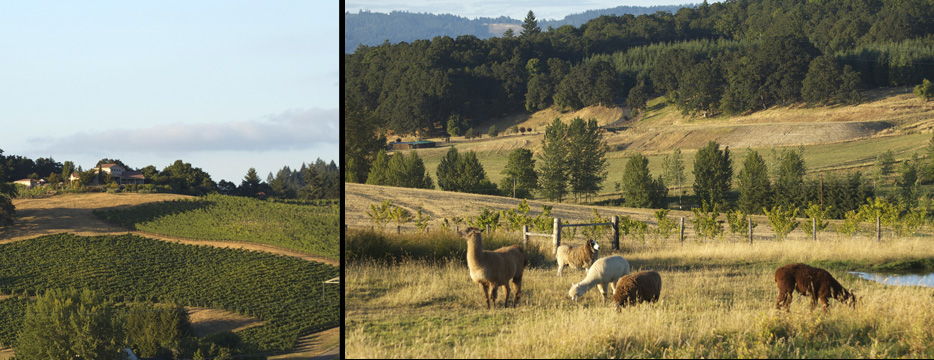
Vineyards and livestock near Abbey Road Farm, Carlton, Oregon

Western concepts of old and new world are linked in both time and space to the renaissance, age of enlightenment, colonization, democracy, science and technology; a new world of cities, goods, rapid communication and transport. Almost anywhere on earth is now close by. Yet something has receded; we long for connections to the pastoral, to the land that we imagine we have lost. But there seems to be evidence of recovery. In some places we see land transformed to the images of an ancient past. Imagine the cultivated vineyards of Mycenaean Greece; herds of goats and sheep on steep stone-strewn hillsides; or further back 12,000 years to Neolithic times at the dawn of agriculture, the domestication of sheep and goats. Our connections are long and deep. These times feel recaptured when I travel through the Dundee hills in Western Oregon. Along Abbey Road you can walk among fields of sheep, alpaca, lamas, and goats; artisan goat cheese is sold locally, Pinot Noir grapes from the vineyards is transformed to red wine permeated with the essences of the land. Are these not the same wines, the same cheese consumed by Aeschylus, Diogenes, and Thucydides? The atoms of that time and place, of the goats, men, and vines, through millennia have cycled between animal and plant, between atmosphere and ocean, diffused and assimilated time after time until the hillside in Oregon is the hillside of ancient Greece. When we drink from a cup of wine, we do indeed drink of the atoms of the blood of the ancients.*

*The carbon atoms in a person’s body, obtained from food are eventually metabolized; some of these atoms are exhaled as carbon dioxide. An average adult is estimated to exhale ~550 liters of CO2 per day. Living to the age of 30 a person might exhale ~ 1.5 x 1029 atoms of carbon in a lifetime. Complete mixing of one human’s 1.5 x 1029 carbon atoms (as carbon dioxide) in ancient times means that every breath that you take today may contain as many as 107 atoms of carbon from that human in every breath you take today. These carbon atoms become part of your body when plants take up atmospheric carbon dioxide and metabolize that to biomaterials that humans transform to edibles (e.g. wine and bread) or by way of livestock vectors (e.g. goats, sheep, cows, which yield milk, cheese and meat).

At Last, All is Quiet

SealFoxGiraffeFrog-all

… MORE PLAY? asked Monster.
“Go to bed,” moaned Lucy.
But monster would not go to bed.

COLD whined Monster.
Lucy drew pajamas.

SCARED
Lucy drew a huggy bear.

DARK
Lucy drew a moon.

Then Lucy crossed her arms.
“That’s enough. Now go to bed.”

NOT SLEEPY
Snapped Monster.

Bronson snapped my book shut. “Stop reading,” he insisted.

I stopped reading.

Against the insignificant gravitational pull of the mattresses, Bronson and Evelyn’s bouncing damped only slightly.

It was late.   The incident of the 90˚ solution was 36,000 kilometers in the past; the earth rushed on towards winter.

I wondered, how do astronauts bounce on their beds in space? Do they read bedtime stories in space?

There was no way out, trapped in this vessel with two alien creatures, there was only one recourse.

“Would you like me to tell you a story?” I asked.

“YES! YES!”,  they exclaimed in unison.

They have certain expectations.

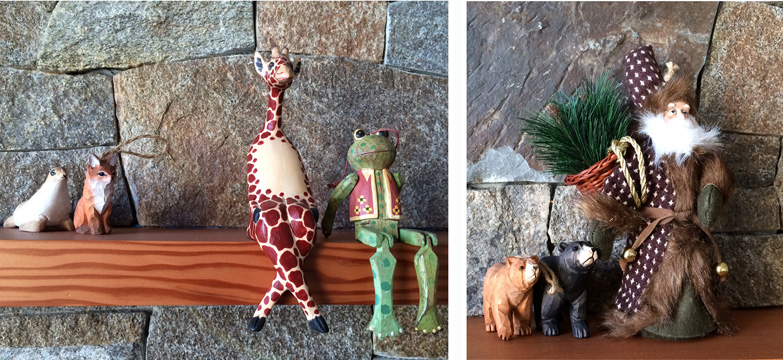
On the mantel above the stone fireplace stands a collection of figures, rescued ornaments of Christmas past.   They sit silently, waiting to be woven into the fabric of stories. Not the stories of Christmas tradition, but stories intertwined with the threads of experiences of Bronson, Evelyn, and Jennie.

They know the how frog saved giraffe, how fox rescued seal, the cubs search for their mother. They are happy to hear a new story, which I prefer over repeating an old story, certain to be admonished for my failure to remember a critical detail.

With neither concern for fineness of word nor rhythm of sentence, the story moves forward maintaining momentum and structure, responding to Bronson and Evelyn until they are satisfied.

At last, all is quiet.

I look at my watch; another 22,000 kilometers.

Excerpt from GO TO BED, MONSTER! By Natasha Wing, with Illustrations by Sylvie Kantorovitz, in Sweet Dreams 5 minute Bedtime Stories, Houghton Mifflin Publishing Company, 2014.