The Making of LightField/MassField


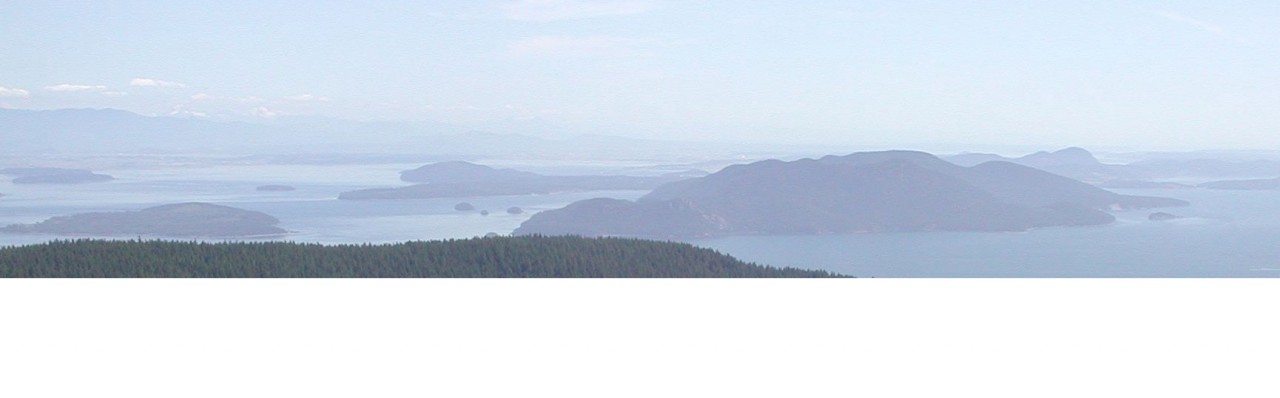
In a number of my postings there are photographs of stones, usually as part of a landscape featuring cliffs and mountains, frequently in association with water. The photograph in the header of Against Edges, taken from the top of Mt. Constitution on Orcas Island, shows a series of Puget Sound islands in the mid-ground and the northern cascade range in the distance. The image in the post Why Against Edges? shows a stone outcropping on the Oregon Coast. San Juan Journey echoes the same theme as does Cascades, At the Edge, and Destiny of Surface.

For my Master of Fine Arts Practicum I began to consider the transformation of stone as core to my final project, to be featured in a gallery show in May 2016. The process evolved from the casting of small stones (typically 2.5” x 5” x 1.5”) in transparent epoxy resin in January of 2016 to an installation measuring 32’ x 24’ x 12’ by May. The final work included 39 “transparent stones”, each cast from a from epoxy resin using silicone molds produced from basalt stone fragments obtained from Bureau of Land Management (BLM) along the Molalla River in Western Oregon. The images featured at the heading to this post show the site from which most of the stones were obtained. By casting in transparent resin the stones became vessels for concepts of transformation. The work included two large-scale graphic images, each composed of twelve 23” x 23” x 1/16” aluminum panels cut by water-jet and 39 wire objects designed to reflect fragmentation and molecular structure. The inspiration for the graphic images came from two sources, Yuichiro Kojiro’s Forms in Japan (the source of Richard Serra’s verb list) and Richard Feynman’s QED: The Strange Theory of Light and Matter. The images do not directly mimic any of the graphics of Kojiro or Feynman but they do play on the concepts of the trajectories and transformation of light and matter. Photographic images of the work are featured in four posts LightField/MassField – Set 1, Set 2, Set 3, and Set 4. Each set contains nine images.

LightField/MassField – Set 1

The Perplexity of Transparency

Malvidin photo

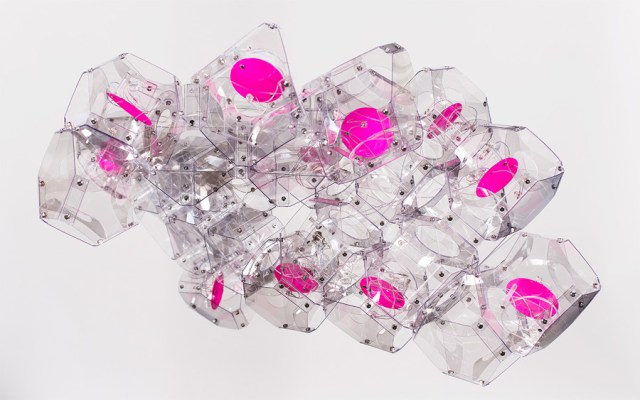
The Perplexity of Transparency – Polycarbonate, stainless steel, copper, light emitting diodes; dimensions variable, as shown 32″ x 23″ x 12″

The Oregon College of Art and Craft annual Art on the Vine auction took place at the Portland Art Museum on Saturday evening, March 5. My work, The Perplexity of Transparency was included among the student commissioned works featured at the auction.   The concept for this work dates back to January 2013. Three years of effort were needed to solve both engineering and aesthetic problems culminating in a work that embraced Art on the Vine as theme. The work represents the essence of the molecular structure that underlies the world of materiality. It can be viewed as a framework for an infinite variety of forms placed within, interwoven among, and protruding from geometric space defined by molecular structure enlarged to the scale of human perception. In it, one encounters the wonder of complexity of form that can emerge from the combination of such simple and primitive geometric shapes as the triangle, rectangle, hexagon, and circle.

Perplexity refers as well back to the original concept, expressed in the first posting on September 14, 2015, that molecules do not have edges. At the level of visual perception, the work, as it represents a molecular structure, has a material edge. However, it is composed of panels of polycarbonate that from some angles are completely transparent, while from others, are highly reflective. The complex interplay of transparency and reflectivity changes in infinite variation as one moves around the work.

Artist statement

From the subatomic world of fundamental particles to supernova, hierarchal assembly brings into existence objects that humans perceive through vision, through hearing, through touch, and though senses of which we are only vaguely aware.  My way of viewing the world is informed through the lens of science. I view materials in terms of molecular constituents and structure. Although invisible, molecules can be imagined through an elaborate set of visual tools and models. The knowledge of all of chemistry and biology is transmitted by way of graphic images of these models. Inspired by the theme, Art on the Vine, I sought to combine the ideas of Pinot Noir grapes, wine, and the red-purple pigment responsible for its color.

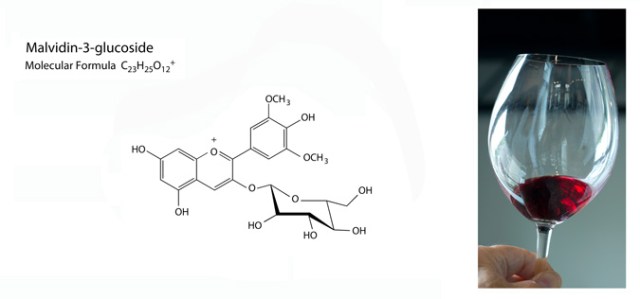
Starting from the molecular structure of malvidin-3-glucoside (a red-purple pigment found in wine grapes), I computationally generated a 3-dimensional structure that enabled me to visualize the framework and electronic nature of the molecule. This was translated into a sculpture that captures ideas of a cluster of grapes, a glass of wine, and the molecular-electronic structure of malvidin-3-glucoside. The sculpture was created from a combination of transparent polycarbonate sheets shaped into tetrahedral and trigonal shapes of carbon and oxygen atoms. The individual shapes were connected using stainless steel screws. The interior of the sculpture was configured with eleven LED lights and dyed synthetic fabric that can absorb blue light and reemit the light at a longer wavelength.   The network of wires through the sculpture exists as a parallel concept to both intracellular networks and the capillary system within the grape vine.

Malvidin photo-2

Structure of the red pigment, malvidin


The sculpture was designed to hang by three 3/64” stainless steel wires (included) from a ceiling (Arakawa hardware includes all materials required for installation into conventional sheetrock without the need for any other reinforcement) and includes a wireless remote dimmer switch and 12v transformer that can be plugged into a standard 120v electrical outlet.

The Gift of (virtual) Conversation

Each Christmas we dream of the next generation of electronic gadget, the one that gives consummate satisfaction and delight. Then, the gadget in hand, disappointment creeps in, satisfaction dissipates. The gurus of Silicon Valley assure us that the ultimate experience is at hand, just a few more improvements and the right apps, and devices of virtual reality will be ….well, reality.

But there is a conundrum, no one seems to know what ‘killer apps’ will most engage the consumer.

Writing in the New York Times, Nick Wingfield* says,

Still unsettled is the question of which experiences will be most compelling. Like many people who have gotten a taste of virtual reality, Ben Schachter, an analyst who follows the game industry at Macquarie Securities, is bullish on the technology. Yet when asked to name a compelling application for it, he struggled. “I haven’t seen that one thing that makes you want to stay in there for hours,” Mr. Schachter said. “I’m frustrated I haven’t seen it yet.” 

A lot of creative people are working to figure out what will be the most compelling virtual reality apps, whether games or movies.

‘Whether games or movies’? There’s the problem, I think neither. I do think that the efforts of the Times to create ‘virtual reality’ experiences as immersive news stories will be fruitful, and as claimed will enhance the experience of the consumer. But I think only incrementally.

So what does have the potential to provide transformative virtual reality experiences? The answer is far more simple than you might expect. It can be summed up in one word, conversation.   Conversation in which the virtual person across from us (or next to us), not only responds to our words and language, but to our emotions, our facial and body language. Conversations that are deep and open-ended. This is not so far fetched.

The 17 July 2015 issue of Science was devoted to the topic of artificial intelligence. If you have access to Science take a look at the photograph on page 248 and the article by John Bohannon, “The Synthetic Therapist”(pp. 250-251).

Imagine now the rate at which the technologies surrounding artificial intelligence are evolving. We are rapidly approaching the satisfaction of the ‘Turing test’, in which the responses of a computer (to a human subject’s questions) are indistinguishable from the responses of a real person. Superimpose on that the technology of facial expression interpretation and a deep database and suitable algorithms for synthesizing responses based on the totality of the recorded writings and digital records of the person with whom you might wish to have a conversation.

We are not there yet, but the trajectory seems to be taking us in this direction. While almost certainly never able to match the warmth of real conversations, there are ways in which these virtual conversations could be compelling. Imagine a conversation in which the avatar has access to the sum total of human knowledge; the ability to deeply respond to every question. Imagine the people with whom you might have conversations, perhaps Maya Angelou, Susan Sontag, Sophocles, Mark Twain, Oscar Wilde, Jane Austen.

I sometimes create a visual work to express my thoughts about a topic. The photographs included with this post are two versions of the idea of the virtual conversation. The imagined subject is Philip Seymour Hoffman, who died tragically of a heroin overdose.   So much left unsaid; what would further conversations reveal?
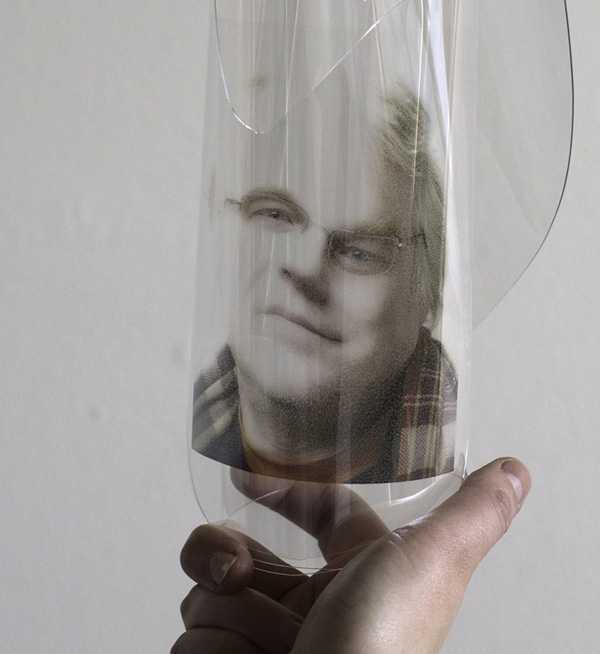
Hoffman-Nov12

The Ghost in the Machine-I, projected image, 2015

Artist Statement

I know how we may talk with the dead. As a visionary, a scientist with deep understanding of the flow of science and technology I imagine what may come to pass. Among these visions are ideas about the ghost in the machine. I envision the confluence of information, data, code, and machine, enabling a new kind of existence. Recombination of fragments of virtual evidence from the cloud, like DNA from the past will enable the re-creation of virtual embodiments of the most engaging of deceased humans.   Influenced by Hamlet’s conversation with the skull of Yorick and Gregory Crewdson’s staged scenes that reflect themes of isolation and loneliness, in longing for connection, I envision the technology of intimate encounters with incorporeal existences.

As an artist I give physicality to these visions, imbued with hints of what may not be quite right, warpages with unseen capacities to evolve into that which we may not want to see, conversations that we may not want to have. The work is expressed through projected digital images of the envisioned encounters.

Note: The work is constituted as a digital image projected onto a white wall.   The height of the image should be at least six feet with the bottom of the image located three feet above the floor.
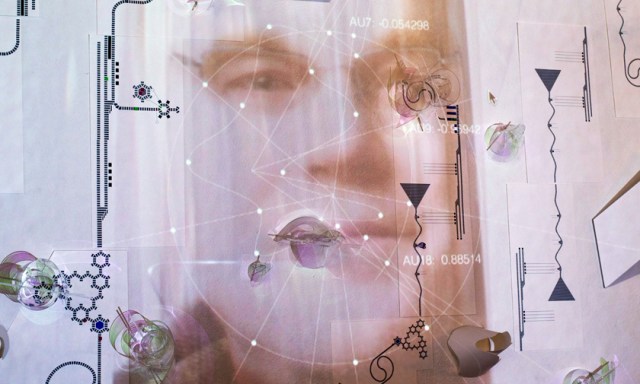
 

GhostinMachine45-2

Ghost in the Machine – II, 2015, projected image
The Dinner Party 2015

DinnerParty-1_22

The Dinner Party 2015

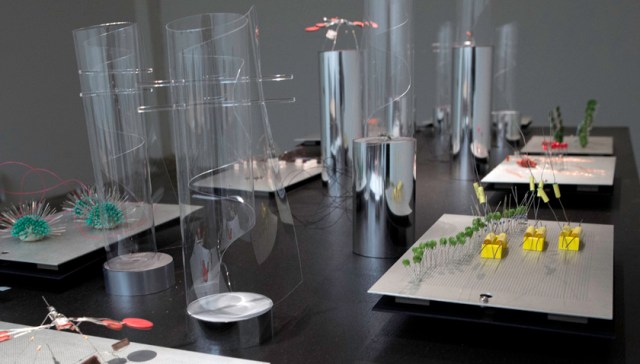
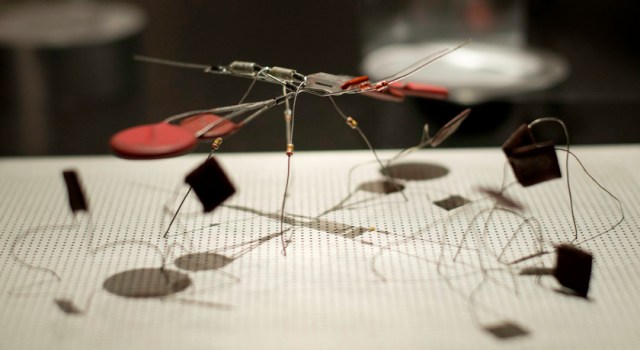
For over two decades, Ferran Adriá chef at El Bulli (Roses, Catalonia, Spain), created some of the most extraordinary dishes in the world. Inspired by the digitalized slide show 1846 and a review by the art critic Roberta Smith (A Culinary Dalí, Delving Into Palettes, New York Times, February 13, 2014),* I thought it might be fun to echo the exuberant creativity of Ferran Adriá by creating a table setting with eight dishes composed of surplus electronic components.  The work was shown at an exhibit of works in progress as part of the MFA in Applied Craft + Design program in Portland, Oregon on December 11, 2015. Like Adria’s culinary creations, my work’s existence will be transitory; the photographs that you see here, the only evidence of its brief existence.


I think that I shall prepare something a little more palatable for Christmas dinner.


DinnerPartyDetail-2

The Dinner Party 2015


Artist Statement:

Chefs are revered for their molecular gastronomical achievements and technological tour de force. Yet, to quote Anton Ego, the fictional food critic in Pixar’s 2007 computer-animated work Ratatouille,

After reading a lot of overheated puffery about your new cook, you know what I’m craving? A little perspective. That’s it. I’d like some fresh, clear, well-seasoned perspective.

My work seeks that perspective.

We are infiltrated, seduced and subjugated by the materials and devices of technology. The purest organic ingredients are laced with unseen traces of emitted synthetics and genetically altered substances.

My work, created from electronic components and contemporary polymers, makes visible this emergent world of cyborgian materials. Materials intimately and irreversibly integrated into our bodies, minds, and souls.


UrchinPlacsetting_4

Place Setting; Culinary Resistance 


FlatCreature-3

Place Setting; Culinary Capacitance


Dragonfly_6

Place Setting;   Whose food?


* 1846 slide show: (http://www.nytimes.com/video/t-magazine/100000002673580/1846-by-ferran-adri.html).

Roberta Smith review: http://www.nytimes.com/2014/02/14/arts/design/ferran-adria-opens-at-the-drawing-center.html?_r=0)

Roberta Smith writes:  As these marvels glide past (in reference to the video 1846), much enlarged, they variously evoke jewelry, sculpture, architecture, landscape architecture, furniture, early Dalí paintings and so forth. Dazzling, unfamiliar and sometimes mouthwatering, they celebrate art in any form as a thrilling, open-ended but all-consuming endeavor.