Imagining the Pastoral

AbbyRoadVines_0299-2

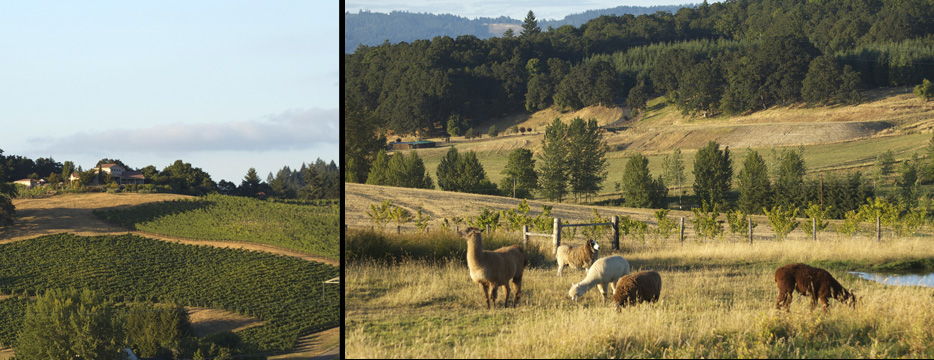
Vineyards and livestock near Abbey Road Farm, Carlton, Oregon

Western concepts of old and new world are linked in both time and space to the renaissance, age of enlightenment, colonization, democracy, science and technology; a new world of cities, goods, rapid communication and transport. Almost anywhere on earth is now close by. Yet something has receded; we long for connections to the pastoral, to the land that we imagine we have lost. But there seems to be evidence of recovery. In some places we see land transformed to the images of an ancient past. Imagine the cultivated vineyards of Mycenaean Greece; herds of goats and sheep on steep stone-strewn hillsides; or further back 12,000 years to Neolithic times at the dawn of agriculture, the domestication of sheep and goats. Our connections are long and deep. These times feel recaptured when I travel through the Dundee hills in Western Oregon. Along Abbey Road you can walk among fields of sheep, alpaca, lamas, and goats; artisan goat cheese is sold locally, Pinot Noir grapes from the vineyards is transformed to red wine permeated with the essences of the land. Are these not the same wines, the same cheese consumed by Aeschylus, Diogenes, and Thucydides? The atoms of that time and place, of the goats, men, and vines, through millennia have cycled between animal and plant, between atmosphere and ocean, diffused and assimilated time after time until the hillside in Oregon is the hillside of ancient Greece. When we drink from a cup of wine, we do indeed drink of the atoms of the blood of the ancients.*

*The carbon atoms in a person’s body, obtained from food are eventually metabolized; some of these atoms are exhaled as carbon dioxide. An average adult is estimated to exhale ~550 liters of CO2 per day. Living to the age of 30 a person might exhale ~ 1.5 x 1029 atoms of carbon in a lifetime. Complete mixing of one human’s 1.5 x 1029 carbon atoms (as carbon dioxide) in ancient times means that every breath that you take today may contain as many as 107 atoms of carbon from that human in every breath you take today. These carbon atoms become part of your body when plants take up atmospheric carbon dioxide and metabolize that to biomaterials that humans transform to edibles (e.g. wine and bread) or by way of livestock vectors (e.g. goats, sheep, cows, which yield milk, cheese and meat).
At Last, All is Quiet

SealFoxGiraffeFrog-all

… MORE PLAY? asked Monster.
“Go to bed,” moaned Lucy.
But monster would not go to bed.

COLD whined Monster.
Lucy drew pajamas.

SCARED
Lucy drew a huggy bear.

DARK
Lucy drew a moon.

Then Lucy crossed her arms.
“That’s enough. Now go to bed.”

NOT SLEEPY
Snapped Monster.

Bronson snapped my book shut. “Stop reading,” he insisted.

I stopped reading.

Against the insignificant gravitational pull of the mattresses, Bronson and Evelyn’s bouncing damped only slightly.

It was late.   The incident of the 90˚ solution was 36,000 kilometers in the past; the earth rushed on towards winter.

I wondered, how do astronauts bounce on their beds in space? Do they read bedtime stories in space?

There was no way out, trapped in this vessel with two alien creatures, there was only one recourse.

“Would you like me to tell you a story?” I asked.

“YES! YES!”,  they exclaimed in unison.

They have certain expectations.

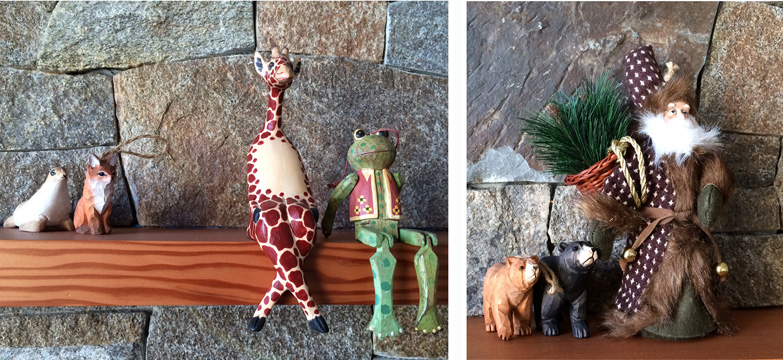
On the mantel above the stone fireplace stands a collection of figures, rescued ornaments of Christmas past.   They sit silently, waiting to be woven into the fabric of stories. Not the stories of Christmas tradition, but stories intertwined with the threads of experiences of Bronson, Evelyn, and Jennie.

They know the how frog saved giraffe, how fox rescued seal, the cubs search for their mother. They are happy to hear a new story, which I prefer over repeating an old story, certain to be admonished for my failure to remember a critical detail.

With neither concern for fineness of word nor rhythm of sentence, the story moves forward maintaining momentum and structure, responding to Bronson and Evelyn until they are satisfied.

At last, all is quiet.

I look at my watch; another 22,000 kilometers.

Excerpt from GO TO BED, MONSTER! By Natasha Wing, with Illustrations by Sylvie Kantorovitz, in Sweet Dreams 5 minute Bedtime Stories, Houghton Mifflin Publishing Company, 2014.

The 90˚ Solution

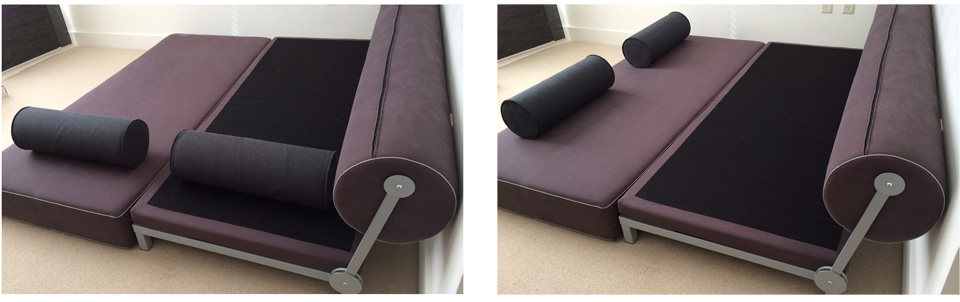
ConvBed-solution

The sofa in the playroom/library separates into two twin size beds. At bedtime, Evelyn lost the race from the living room; Bronson bounced jubilantly on the springier one.   Evelyn was devastated; she lunged towards Bronson. When pulled back, she burst into tears. The severity of the confrontation was certain to escalate.

“Evie, would you like to take a bath?” I asked calculatedly.   Through the flood of tears she shook her head yes. The predictable asynchrony of bath water and tears is mystery that I think may one day be solved.

As Evelyn caracoled in warm water I returned to the bedroom. Bronson continued his joyful territorial bounce. Two beds, edge against edge, separate unequal neighborhoods. I looked at the beds, then at Bronson; then at the two pillows at the head of each bed. I lifted each pillow, and placed them back down. Bronson continued to jump on the same spot, but I could see that he understood what I had done. When Evelyn came back from the bath wrapped in the towel, they jumped together.

On Drawing

Sketchbook

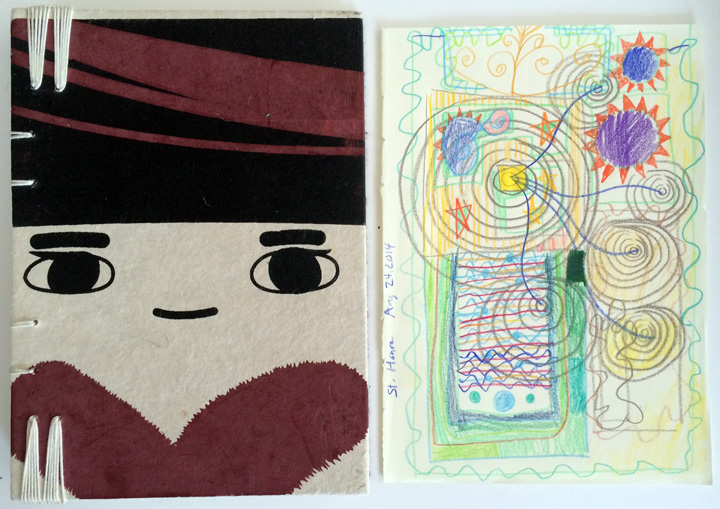
Sketch book cover and early drawing from August 2014. The book was filled by August 2015.

Even before we ordered, Jennie would usually draw the beginnings of a complex pattern in one or two colors. Some times she would foil me by quickly drawing in as many different colors as she could before handing me the sketchbook.   If she had drawn curvy lines, then I would draw straight. If she drew circles I would draw squares, boxing in her circles. She would decorate my squares with squiggly lines. If she drew magenta lines, then I would draw green. When I tried to block the flow of her lines, she would boldly cover my lines with more aggressive marks.

By the time breakfast arrived the page was usually filled with our competing marks. I almost always conceded. When at the end of summer our Sunday sketchbook became filled, we began a larger one. But her first marks were no longer abstract squiggly lines, she had drawn a pony with large eyes and flowing mane. I looked admiringly at the picture but did not draw on the page.

On Climbing


Evie Magic Forest-2sm

Wanting to climb higher,
her reach insufficient
to be gathered
by higher branches,

Evelyn wonders
if a girl who is taller,
limbs more agile
will come next year.

Perhaps the tree will embrace her.
Evelyn asks whether the tree will still be there.
Yes, I reply.
She climbs down.

The Destiny of Surface

Rock-growth

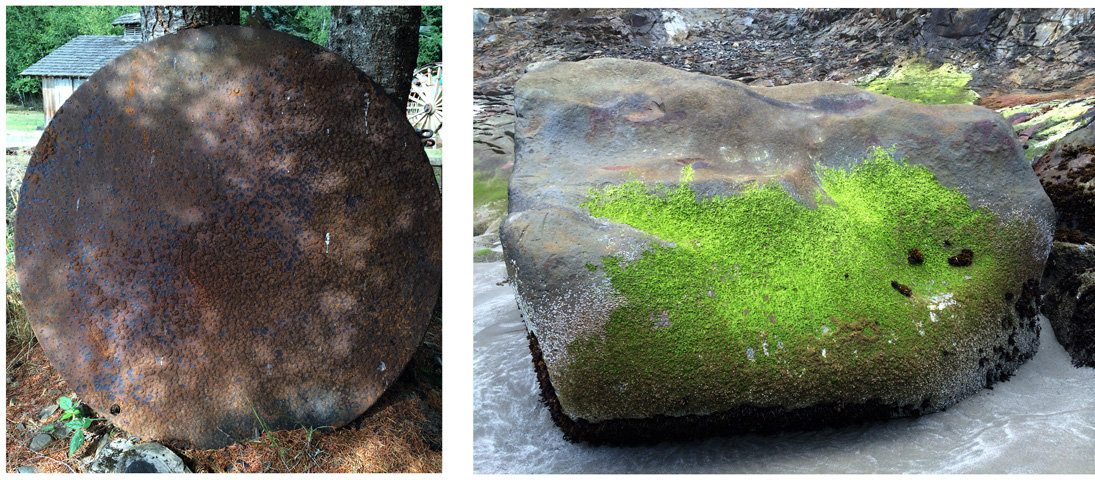
Iron disk at Camp 18; Stone on the beach, Ostwald West State Park.

It does not seem to matter, edges, surfaces, none will last. The unrelenting assault by air, water, microorganism, blowing particles, transforms crystalline substance to a labyrinthine of complex material. At edges, growth and decay are indistinguishable. Mineral aggregate a foundation for rooting, iron in love with oxygen, in exothermic bursts combine. An explosion of amorphous form erupts outward embracing the atmosphere. Curious that there is such an affinity for the eye and mind of man.

On the Trail

BronsonEvieTrail

Bronson and Evelyn on a trail in Western Oregon.

When we go for hikes in the forest Bronson takes the lead. There are sometimes side paths that lead off into mazes of bushes. It is always these paths that Bronson insists on following. Sometimes I can’t tell that there is a path; he is certain. I asked him why. He says he doesn’t’ know. But what can I expect of explanation from a five year old? Evelyn follows him, so I follow her, and down the less-traveled path we head. Evelyn is even less likely to provide an explanation, she’s just 3 ½. I don’t think explanation is necessary. Lacking complication, we have lots of fun.

Rising Star Café

RisingStarCafeComposite

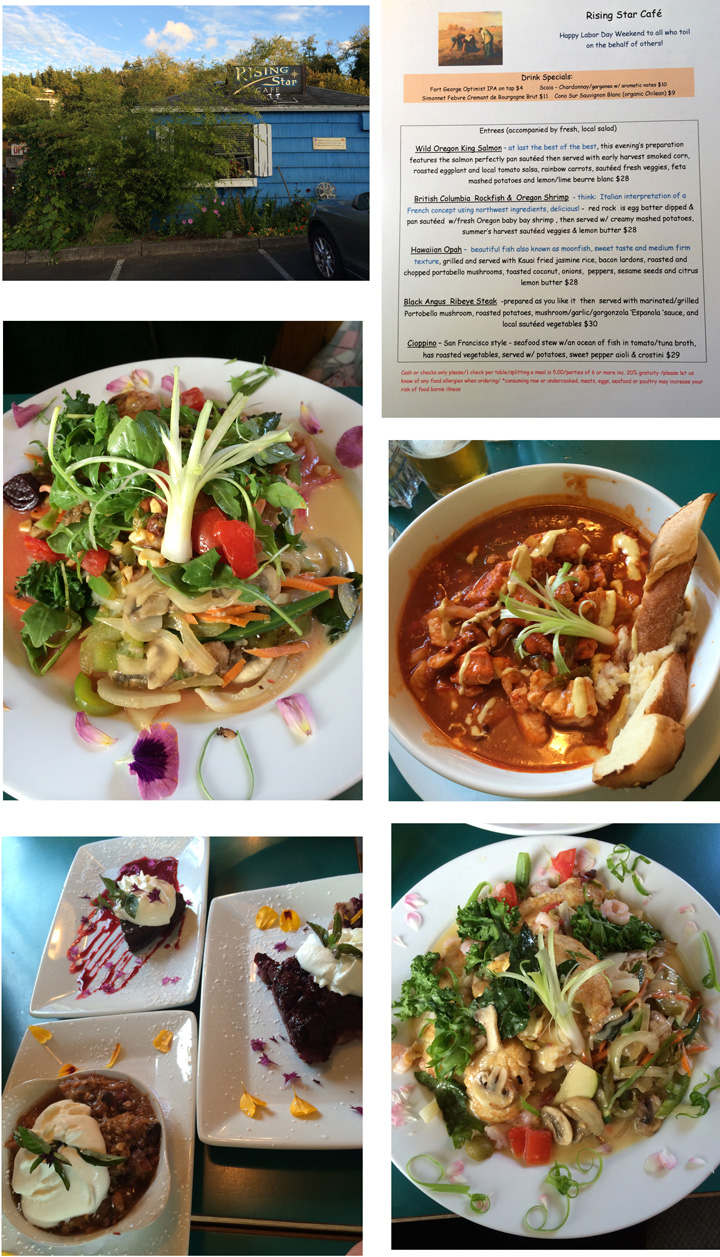
Rising Star Café, Wheeler, Oregon – clockwise from top left, café building, menu on September 6, 2015, Cioppino, British Columbia Rockfish, three desserts, and Wild Oregon King Salmon.

At the edge of the estuary, in sight of Neahkahnie mountain, just off highway 101, in the town of Wheeler, hidden behind a massing of blooms and a tangle of plants, is the Sunrise Café. There’s space for about 16 guests inside and perhaps as many on the patio outdoors.   The food is uncommon, each dish layers of taste and texture, enveloped by sauces that seem well matched to the critical palates of our family. And indeed when you enter, you seem to be welcomed as family. It was my impression on both of our visits that the guests around us were people who had returned again and again. We are by no means food critics, but as residents of Portland have accumulated considerable experience with Northwest cuisine. The Sunrise Café in comparison, while not experimental in the Portland sense, is just purely delightful.

Nehalem

Wheeler dock

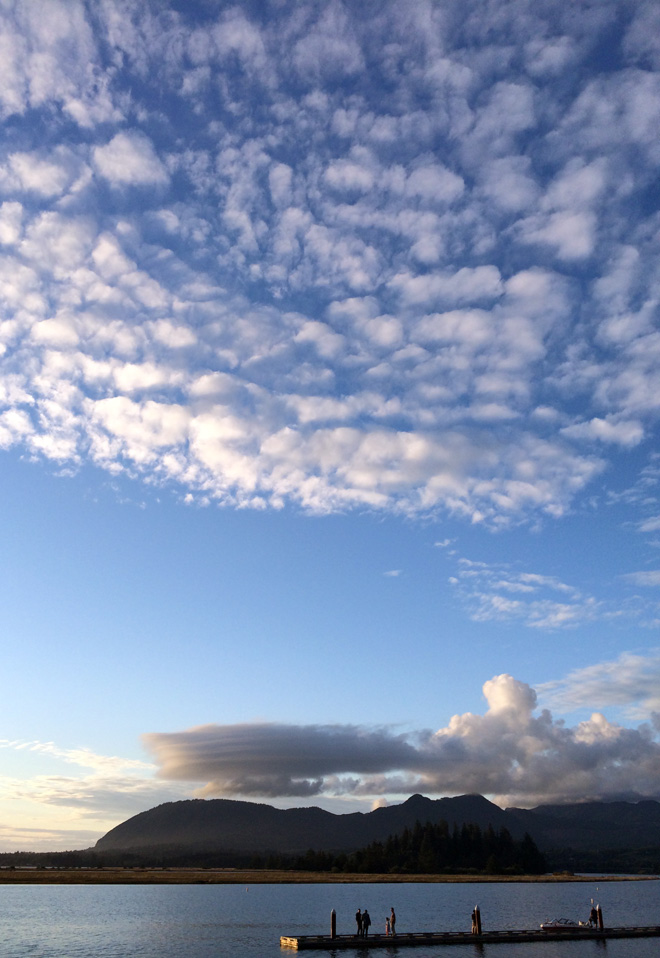
Nehalem river estuary looking north towards Neahkahnie Mountain.

Few places are more fascinating than the edges of continents where sea, land, and sky collide. Minutes before the photograph was taken, shortly before sun set, a fisherman, aided by a friend and his net, landed a seventeen-pound salmon on the dock. His memory of that day will likely be totally encapsulated in the climax of the catch. Yet prior to the catch he had been immersed in an extraordinary setting, imperceptibly evolving around him over the course of the entire day. I suspect such experiences are recorded in the mind below memory, unconsciously retrievable combinations of feelings and emotions. I imagine it as a metamorphosis of the mind linked to atmosphere and landscape, weather and shadows, occurring continuously minute-to-minute, day-by-day, year-to-year, for the remainder of our lives.

Featured

Why Against Edges?

OregonCoastLookingSouth
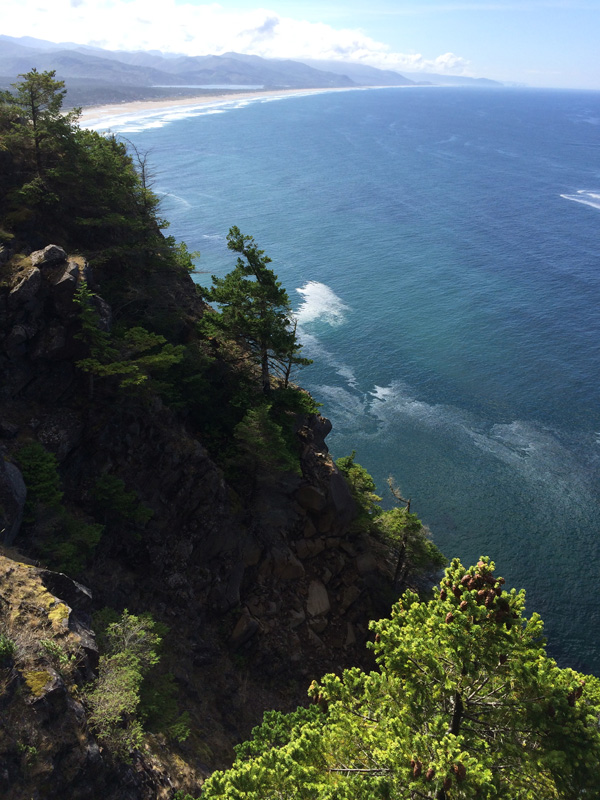
Oregon coast – Looking south towards Nehalem Bay

The genesis of the title came from an innocent statement in a conversation with Victor Maldonado in which I said,

“you know, molecules have no edges.”

Victor has not let me forget; we still often times begin new conversations with a restatement of that concept.

Now, I have no intention, at least at this point, of explaining the scientific concept of the lack of edges (or surfaces) associated with molecules. But, because of Victor I am beginning to catch glimpses of the implications of this concept. The depth and breath of subjects that relate to the concept are far too great for an individual to fully explore and comprehend. Nevertheless the notion of the quest is compelling, and this blog a mechanism for its documentation.

In the phrase, Up against the edge of a cliff, there is an implication of danger, just as there is with the phrase, against the edge of a knife. Yet both also imply opportunity. When you step over the edge you enter the territories of the unknown, the regions where discoveries may be made.   Retreat from the edge could be interpreted as prudent caution, but it may also imply a fear of the unknown and possibly even a poverty of curiosity. But should one have concerns at all when the journey is into the territories of the imagination? Here, isn’t risk nothing more than an abstract concept? That depends. Are you prepared to subject deeply ingrained beliefs, ones that may serve as guiding principles for the conduct of your life, to highly infectious ideas?

Edges are interfaces, places where matter and ideas between domains mix and cross-fertilize. The connections and re-combinations that follow are the source of new ideas, new forms, and new understandings. Therein lies the essence of my intentions, imagining connections, correspondences, juxtapositions, and relationships that would not otherwise exist; in short my imagination does not allow separations between ideas and forms. I am against imaginary borders implied by edges.