The Perplexity of Transparency

Malvidin photo

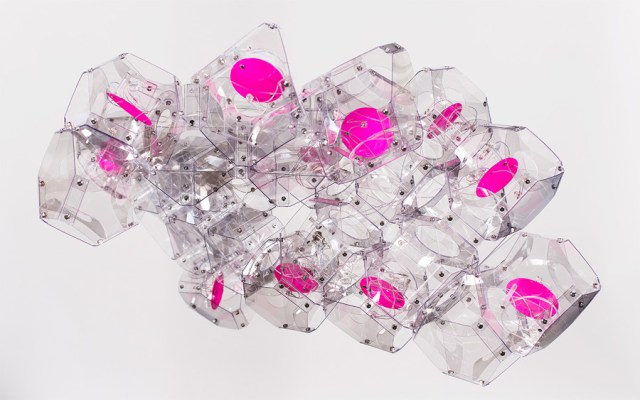
The Perplexity of Transparency – Polycarbonate, stainless steel, copper, light emitting diodes; dimensions variable, as shown 32″ x 23″ x 12″

The Oregon College of Art and Craft annual Art on the Vine auction took place at the Portland Art Museum on Saturday evening, March 5. My work, The Perplexity of Transparency was included among the student commissioned works featured at the auction.   The concept for this work dates back to January 2013. Three years of effort were needed to solve both engineering and aesthetic problems culminating in a work that embraced Art on the Vine as theme. The work represents the essence of the molecular structure that underlies the world of materiality. It can be viewed as a framework for an infinite variety of forms placed within, interwoven among, and protruding from geometric space defined by molecular structure enlarged to the scale of human perception. In it, one encounters the wonder of complexity of form that can emerge from the combination of such simple and primitive geometric shapes as the triangle, rectangle, hexagon, and circle.

Perplexity refers as well back to the original concept, expressed in the first posting on September 14, 2015, that molecules do not have edges. At the level of visual perception, the work, as it represents a molecular structure, has a material edge. However, it is composed of panels of polycarbonate that from some angles are completely transparent, while from others, are highly reflective. The complex interplay of transparency and reflectivity changes in infinite variation as one moves around the work.

Artist statement

From the subatomic world of fundamental particles to supernova, hierarchal assembly brings into existence objects that humans perceive through vision, through hearing, through touch, and though senses of which we are only vaguely aware.  My way of viewing the world is informed through the lens of science. I view materials in terms of molecular constituents and structure. Although invisible, molecules can be imagined through an elaborate set of visual tools and models. The knowledge of all of chemistry and biology is transmitted by way of graphic images of these models. Inspired by the theme, Art on the Vine, I sought to combine the ideas of Pinot Noir grapes, wine, and the red-purple pigment responsible for its color.

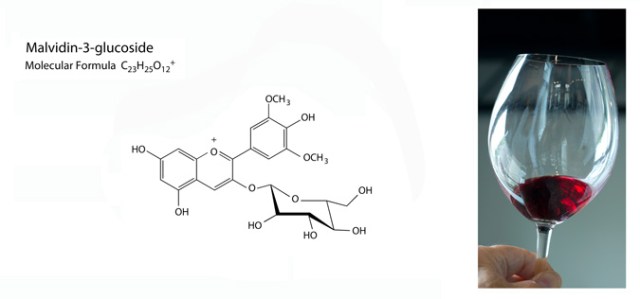
Starting from the molecular structure of malvidin-3-glucoside (a red-purple pigment found in wine grapes), I computationally generated a 3-dimensional structure that enabled me to visualize the framework and electronic nature of the molecule. This was translated into a sculpture that captures ideas of a cluster of grapes, a glass of wine, and the molecular-electronic structure of malvidin-3-glucoside. The sculpture was created from a combination of transparent polycarbonate sheets shaped into tetrahedral and trigonal shapes of carbon and oxygen atoms. The individual shapes were connected using stainless steel screws. The interior of the sculpture was configured with eleven LED lights and dyed synthetic fabric that can absorb blue light and reemit the light at a longer wavelength.   The network of wires through the sculpture exists as a parallel concept to both intracellular networks and the capillary system within the grape vine.
Malvidin photo-2

Structure of the red pigment, malvidin


The sculpture was designed to hang by three 3/64” stainless steel wires (included) from a ceiling (Arakawa hardware includes all materials required for installation into conventional sheetrock without the need for any other reinforcement) and includes a wireless remote dimmer switch and 12v transformer that can be plugged into a standard 120v electrical outlet.
A Simple Gift

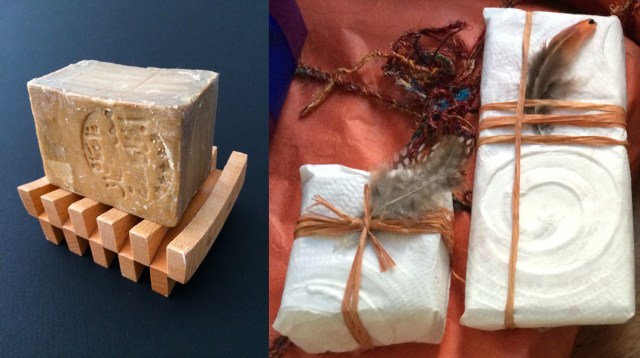
Aleppo soap

A Gift of Soap

From the earth
a simple gift
wrapped in paper
made by hand

no bow
just a feather
in remembrance

soap from laurel
from Aleppo
to wash away tears

shower drops
cascade onto tile
carrying fragments
of us

to the sea

an ocean beach
a small boy
face in the sand

returned to earth


The Best Gifts are the Ones You Make

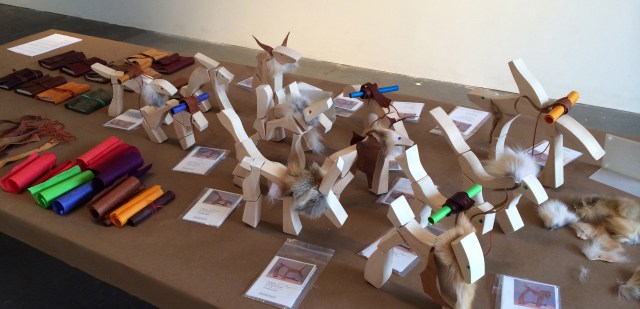
I think perhaps the best Christmas gifts of the past few years were the creatures that I made from blocks of Port Orford Cedar. I cut the wood and sanded each piece by hand; although well made, they were also just sufficiently flawed that they could not be mistaken for a mass produced toy. Of the twenty-five made, no two were alike. The creatures could be disassembled and reassembled in many different ways.

Creature March-0981

Wood block creatures

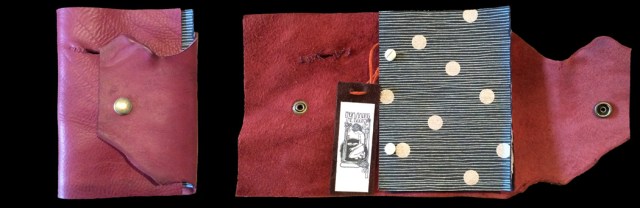
Each was accompanied by a blank journal through which a child could share their thoughts with the creature. The journals were unusual; made of scrap leather, most had imperfections that needed to be repaired by stitching. And yet there was something about them; like the creatures they were mysteriously endearing despite their flaws.

Wood block creature with scroll; Jennie writing in accompanying journal

I will make something different next year; I’m not certain what, but fortunately I needn’t worry; what ever it wants to be, will let me know in time.

Leather_0975Composite.jpg Leather bound journal


Instructions accompanying each wood block creature          

Your creature is completely unique; although it may resemble a familiar animal, it does not actually represent any known animal. Use your imagination to create a myth about its origin and history. We only know that at one time it was part of a living ecosystem in Southwest Oregon.

First steps:

  1. Name your creature: write the name just below its picture on the included 4 x 5 ¾ inch note card, and place the card in your journal.
  2. Take your creature completely apart and, using the picture as a guide, reassemble.
  3. Try putting your creature together in different ways.
  4. Keep a journal in which you can create stories about yourself and your creature.

A bedtime routine (a guide for parents):

Shortly before bedtime sit with your child and ask them what they have done today. Encourage them to talk about the best and worst experiences of the day.   Ask your child to spend a few minutes writing on a page from their journal about their experiences of the day.   If your child is too young to write, then write for them. To share your experiences with your creature, wrap the page in a piece of scroll paper (included) and leather cape (included) and place on the back of the creature overnight. Transfer the page to your journal (optional) in the morning.

Visual memory game:

A set of block pieces can be assembled in many different sequences and patterns. Two players can take turns assembling the blocks in a distinct pattern, then disassembling the pattern and challenging the second player to reassemble the blocks in exactly the same way. This works well in conjunction with a smart phone camera to record each pattern before disassembly. Start with just a few pieces and gradually work up to all the pieces for your creature (this can be challenging, even for adults).

Care of your wood block creature:

The wood is untreated and will accumulate marks from play over time. These can be removed by light sanding with fine sandpaper (150 to 220 grit). Alternatively you can protect your wood blocks by coating them with common floor wax or cutting block oil. However, if you do this you will lose the smell of the natural wood.

Parts:

6 to 8 Port Orford cedar blocks
¼” diameter polyethylene connectors
leather cape and scroll paper
leather journal


The Gift of (virtual) Conversation

Each Christmas we dream of the next generation of electronic gadget, the one that gives consummate satisfaction and delight. Then, the gadget in hand, disappointment creeps in, satisfaction dissipates. The gurus of Silicon Valley assure us that the ultimate experience is at hand, just a few more improvements and the right apps, and devices of virtual reality will be ….well, reality.

But there is a conundrum, no one seems to know what ‘killer apps’ will most engage the consumer.

Writing in the New York Times, Nick Wingfield* says,

Still unsettled is the question of which experiences will be most compelling. Like many people who have gotten a taste of virtual reality, Ben Schachter, an analyst who follows the game industry at Macquarie Securities, is bullish on the technology. Yet when asked to name a compelling application for it, he struggled. “I haven’t seen that one thing that makes you want to stay in there for hours,” Mr. Schachter said. “I’m frustrated I haven’t seen it yet.” 

A lot of creative people are working to figure out what will be the most compelling virtual reality apps, whether games or movies.

‘Whether games or movies’? There’s the problem, I think neither. I do think that the efforts of the Times to create ‘virtual reality’ experiences as immersive news stories will be fruitful, and as claimed will enhance the experience of the consumer. But I think only incrementally.

So what does have the potential to provide transformative virtual reality experiences? The answer is far more simple than you might expect. It can be summed up in one word, conversation.   Conversation in which the virtual person across from us (or next to us), not only responds to our words and language, but to our emotions, our facial and body language. Conversations that are deep and open-ended. This is not so far fetched.

The 17 July 2015 issue of Science was devoted to the topic of artificial intelligence. If you have access to Science take a look at the photograph on page 248 and the article by John Bohannon, “The Synthetic Therapist”(pp. 250-251).

Imagine now the rate at which the technologies surrounding artificial intelligence are evolving. We are rapidly approaching the satisfaction of the ‘Turing test’, in which the responses of a computer (to a human subject’s questions) are indistinguishable from the responses of a real person. Superimpose on that the technology of facial expression interpretation and a deep database and suitable algorithms for synthesizing responses based on the totality of the recorded writings and digital records of the person with whom you might wish to have a conversation.

We are not there yet, but the trajectory seems to be taking us in this direction. While almost certainly never able to match the warmth of real conversations, there are ways in which these virtual conversations could be compelling. Imagine a conversation in which the avatar has access to the sum total of human knowledge; the ability to deeply respond to every question. Imagine the people with whom you might have conversations, perhaps Maya Angelou, Susan Sontag, Sophocles, Mark Twain, Oscar Wilde, Jane Austen.

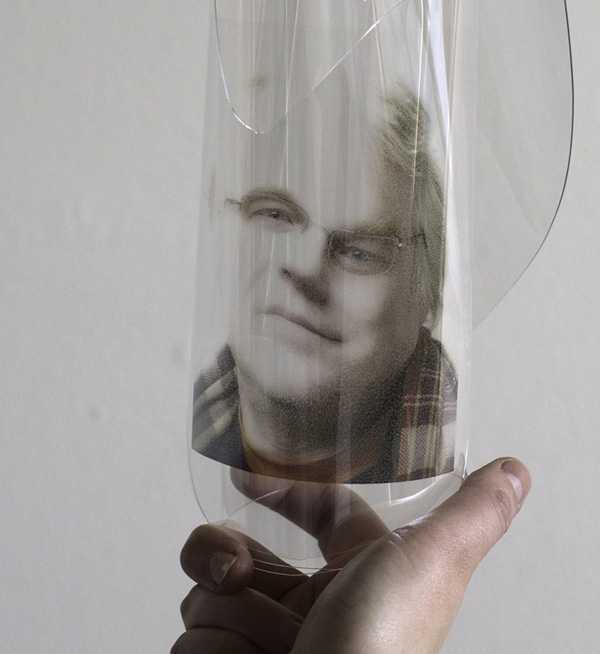
I sometimes create a visual work to express my thoughts about a topic. The photographs included with this post are two versions of the idea of the virtual conversation. The imagined subject is Philip Seymour Hoffman, who died tragically of a heroin overdose.   So much left unsaid; what would further conversations reveal?

Hoffman-Nov12

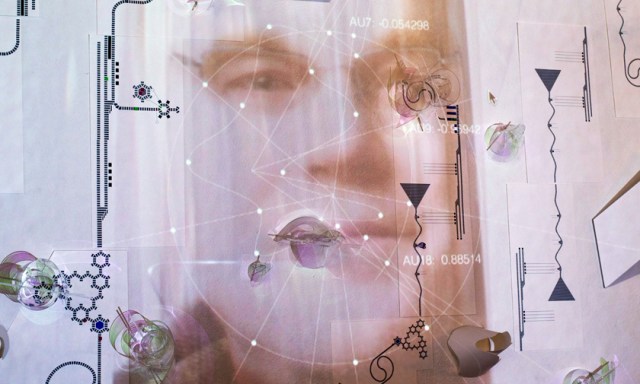
The Ghost in the Machine-I, projected image, 2015

Artist Statement

I know how we may talk with the dead. As a visionary, a scientist with deep understanding of the flow of science and technology I imagine what may come to pass. Among these visions are ideas about the ghost in the machine. I envision the confluence of information, data, code, and machine, enabling a new kind of existence. Recombination of fragments of virtual evidence from the cloud, like DNA from the past will enable the re-creation of virtual embodiments of the most engaging of deceased humans.   Influenced by Hamlet’s conversation with the skull of Yorick and Gregory Crewdson’s staged scenes that reflect themes of isolation and loneliness, in longing for connection, I envision the technology of intimate encounters with incorporeal existences.

As an artist I give physicality to these visions, imbued with hints of what may not be quite right, warpages with unseen capacities to evolve into that which we may not want to see, conversations that we may not want to have. The work is expressed through projected digital images of the envisioned encounters.

Note: The work is constituted as a digital image projected onto a white wall.   The height of the image should be at least six feet with the bottom of the image located three feet above the floor.


GhostinMachine45-2

Ghost in the Machine – II, 2015, projected image

The Dinner Party 2015

DinnerParty-1_22

The Dinner Party 2015

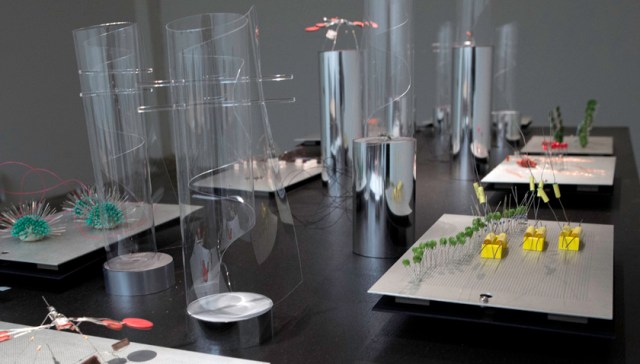
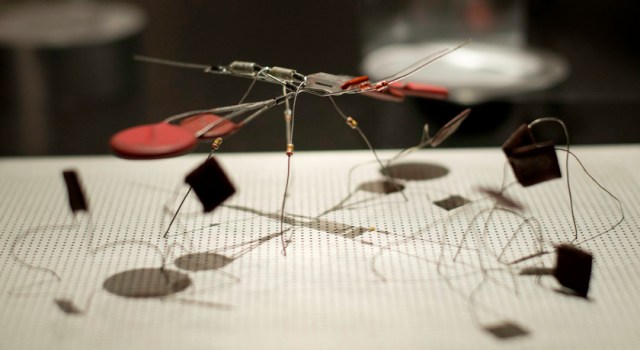
For over two decades, Ferran Adriá chef at El Bulli (Roses, Catalonia, Spain), created some of the most extraordinary dishes in the world. Inspired by the digitalized slide show 1846 and a review by the art critic Roberta Smith (A Culinary Dalí, Delving Into Palettes, New York Times, February 13, 2014),* I thought it might be fun to echo the exuberant creativity of Ferran Adriá by creating a table setting with eight dishes composed of surplus electronic components.  The work was shown at an exhibit of works in progress as part of the MFA in Applied Craft + Design program in Portland, Oregon on December 11, 2015. Like Adria’s culinary creations, my work’s existence will be transitory; the photographs that you see here, the only evidence of its brief existence.


I think that I shall prepare something a little more palatable for Christmas dinner.


DinnerPartyDetail-2

The Dinner Party 2015


Artist Statement:

Chefs are revered for their molecular gastronomical achievements and technological tour de force. Yet, to quote Anton Ego, the fictional food critic in Pixar’s 2007 computer-animated work Ratatouille,

After reading a lot of overheated puffery about your new cook, you know what I’m craving? A little perspective. That’s it. I’d like some fresh, clear, well-seasoned perspective.

My work seeks that perspective.

We are infiltrated, seduced and subjugated by the materials and devices of technology. The purest organic ingredients are laced with unseen traces of emitted synthetics and genetically altered substances.

My work, created from electronic components and contemporary polymers, makes visible this emergent world of cyborgian materials. Materials intimately and irreversibly integrated into our bodies, minds, and souls.


UrchinPlacsetting_4

Place Setting; Culinary Resistance 


FlatCreature-3

Place Setting; Culinary Capacitance


Dragonfly_6

Place Setting;   Whose food?


* 1846 slide show: (http://www.nytimes.com/video/t-magazine/100000002673580/1846-by-ferran-adri.html).

Roberta Smith review: http://www.nytimes.com/2014/02/14/arts/design/ferran-adria-opens-at-the-drawing-center.html?_r=0)

Roberta Smith writes:  As these marvels glide past (in reference to the video 1846), much enlarged, they variously evoke jewelry, sculpture, architecture, landscape architecture, furniture, early Dalí paintings and so forth. Dazzling, unfamiliar and sometimes mouthwatering, they celebrate art in any form as a thrilling, open-ended but all-consuming endeavor.


The Riches of Christmas


JessicaHelgerson

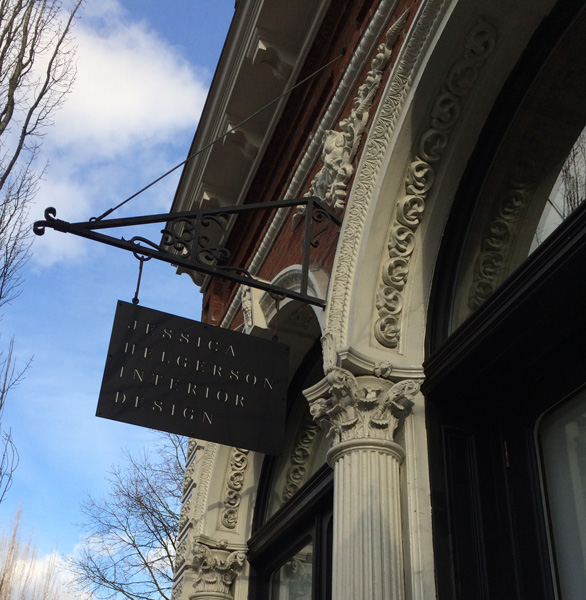
Jessica Helgerson Interior Design, Portland, Oregon

Christmas still feels like a magic time. Christmas music, decorations, and lights that surround us are catalysts for memories from childhood. The trip to the foothills of the cascades to harvest a tree, time spent around the dinner table with family, the warmth of home bring into focus that which is most important to us. The approach to crescendo occurs in the delight of children scrambling about the Christmas tree searching for presents tagged with their names.

Then there are the gifts that come in the form of unanticipated encounters; encounters with mysterious objects that peak curiosity while defying explanation.


RathbunWorkNov2015-2

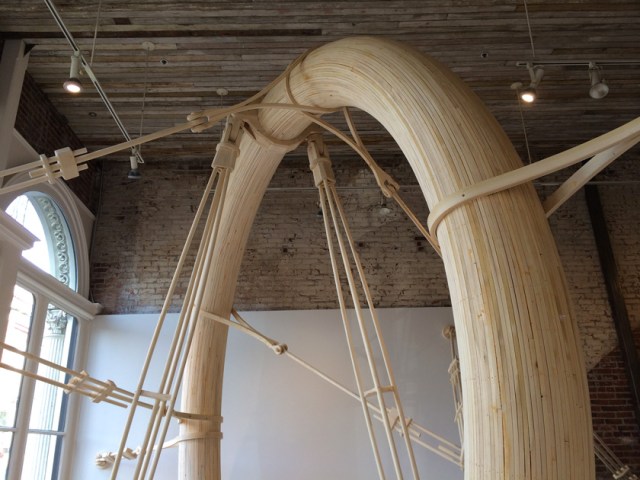
Mike Rathbun, I Have Love in my Heart as a Thief has Riches

The form of the encounter was a sculpture installed inside the Jessica Helgerson Interior Design Studio in downtown Portland. The work by Mike Rathbun, titled I Have Love in my Heart as a Thief Has Riches,  is an exquisitely crafted wood structure (see posted photographs). The work is open to a wealth of interpretations, yet there was one association in which I became entrapped. The building’s classical façade, with Corinthian columns evoke ancient civilizations. The sculpture, which stands just inside the door, somehow evoked, and then immersed me in the journey of Odysseus; lost at sea, seeking, tenuous moorings, the longing for home and connection.

The work is simply astonishingly beautiful; difficult to say more. One needs to experience it in person. Jessica Helgerson Interior Design is located at 112 SW First Avenue, Portland, OR.


Rathbun_2726


Fictionally Refined Non-Fiction

Fiction-Non-fiction

I am perplexed by the categorization of written works as fiction or non-fiction. I find it impossible to make clean distinction. Virtually all fiction contains elements of non-fiction, and virtually all works claimed as non-fiction contain information that is simply wrong, often times because of the natural nebulosity of information rather than because of author’s intentions.

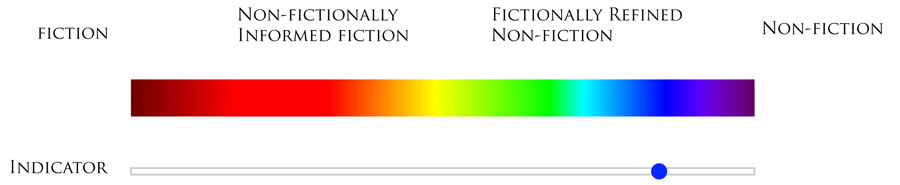
I’m interested in yet another kind of non-fiction, work that is mostly true, but purposely manipulated for artistic effect. In my own work, to improve the flow of language and ideas, I may alter original statements and the order in which these statements were made, but I try to remain as faithful as possible to the original context and meaning. I call the resulting writing fictionally refined non-fiction.  For the fun of it I created a graphic (Figure above) that expands literature into an infinite number of categories, with all works located somewhere on a continuum spanning fiction, non-fictionally informed fiction, fictionally refined non-fiction, and non-fiction. Non-fictionally informed fiction includes works that are intentionally fiction, but contain elements of setting and event that recognizably exist or existed.

In the absence of author(s), the position of a work on the scale is guided by the consensus of knowledgeable authority, which may change over time. For example, scientific papers, when first published, would be expected to fall on the far right side of the scale (non-fiction). But as years pass and new discoveries are made, scientific reports frequently slide towards fiction.

Posts on the Against Edges blog will typically fall on the scale between 50 and 95% non-fiction. Examples of ways that I fictionally refine non-fiction can be found in the September 19 posting in which I imagine the thoughts of a young girl climbing a tree. This posting leans towards fiction since the thoughts are imaginary. The 90˚ Solution posting on September 22 is almost entirely factual, but I may not have recorded the original question, “Evie, would you like to take a bath?” with perfect accuracy.

At the Edge

Yosemite

Above Yosemite Valley

This blog was started as a means to learn to write about my experiences; my guides: William and Kim Stafford, Annie Dillard, Jorge Borges, and Italo Calvino. A writing workshop with Kim at Leland Ironworks in March was revelatory. Other authors will follow. By writing to post on line, I forced myself to spend more time editing my work. As I look back over the past few weeks, I see lots of room for improvement. I think shorter posts work better. I like ideas that are expressed with economy of words.

Although not always obvious, the theme, against edges, seems to have been sustained. The challenge remains; at edges, where there are no barriers, we always seem to create our own. Moreover, it is the imperceptible barriers that are the most perplexing.   This then is another reason for writing; to discover those barriers that define edges that we did not know existed.

On Geometry

Fog-Bridge

Tilikum Crossing suspension bridge under construction

For nearly two years my walks north along the Willamette River passed the construction site of the Tilikum Crossing suspension bridge (now completed). Like other structures nearby, the bridge is a bold superimposition of Euclidian geometry upon the natural rhythmic chaos of nature. This past Thursday on the way to gallery openings in Portland’s Pearl district I barely noticed the bridge as I walked by.   But on the way back it once again loomed large in the landscape. Its geometry had assumed new meaning.

At Froelich Gallery, Michael Schulthesis’s paintings explode with mathematical equations interspersed with geometric shapes described within the polar coordinate system, as maps of mind in which memories continuously intersect with and overwrite other memories. The shapes that float through space morph between the precision of mathematics and the biomorphic forms of jellyfish, that in fact were variations of the limaçon of Pascal. At Blackfish Gallery, Heather Songbird’s Semblant Geometries, Euclidian geometric constructions become metaphors for tales from Karel Jaromirs Erben’s North-West Slav Legends and Fairy Stories from 1897. Across 9th street at Elizabeth Leach Galleries, the theme of Lee Kelly’s steel sculptures and works on paper reference the Observatory at Jaipur, a World Hertiage site in Jaipur India, renown for its architectural scale astronomical instruments dating from the early 18th century. Here one finds the geometry of ancient celestial co-ordinate systems in play.

At Whitebox, on 1st Avenue Katherine Longstreth documented choreographic process, movement, of head, shoulders, arms, torso, legs, feet; intersecting arcs, rhythms in time and space, sensuous geometries.   Her show, Marginal Evidence (an interactive experience of dance-making) was an ode to the exceptional efforts that an artist makes to create geometric relationships in time. Here the x,y,z, Cartisian coordinate system of an individual human body practicing in the studio or performing on stage lies superimposed within the much more expansive coordinates of space and time defined by culture, city, country, and world.

On this mild October evening, as my mind filled with thoughts of geometric relationships expressed in movement, paint, steel, and the narrative arc of folk tales, I began to imagine yet another kind of geometry, one which describes the topology of conversation.  There was a distinct and satisfying asymmetry to the conversations of the evening, first with Michael Schulthesis and then with Heather Birdsong. It was the asymmetry of intentional and inquisitive listening punctuated only by questions and comments of interpretation.. In the geometry of proximity, the infectious connectivity of their ideas, for a short time I joined the artists on their journeys.

Imagining the Pastoral – Part 2

The landscape of my childhood was the barren hills of Eastern Oregon, cowboy culture, the Native Americans of the Umatilla tribe, the Blue Mountains, Columbia and Snake Rivers, the route of Lewis and Clark, of Sacajawea. As a young child, in play and in craft, I led an imaginary life that bridged the borderlands between cowboy and Native American culture. On Saturday morning I would harvest scrap leather from the bins at Hamley & Co, makers of saddles, belts, cowboy gear. Objects that I fashioned from these scraps functioned as props for imaginary role-playing.

The gathering of the tribes at roundup time, the ceremony and pageantry of Happy Canyon, these were the foundations of my interests and impressions of the mystic of the native American, celebrating the eternal cycle of nature while living in and with the land. Even at a young age I was well aware that the ethos of western culture founded on principles of conquest and acquisition had created the 20th century pathos of the First People’s of the Americas.

In those years the meat in our diet was elk and deer, harvested by rifle in the fall, which we stored frozen through the winter. Thanksgiving and Christmas meals were celebrated with Pheasant. Animal skins, leather, wool; these are the materials of my childhood that I most fondly recollect.

Years later these materials continue to engage my imagination.

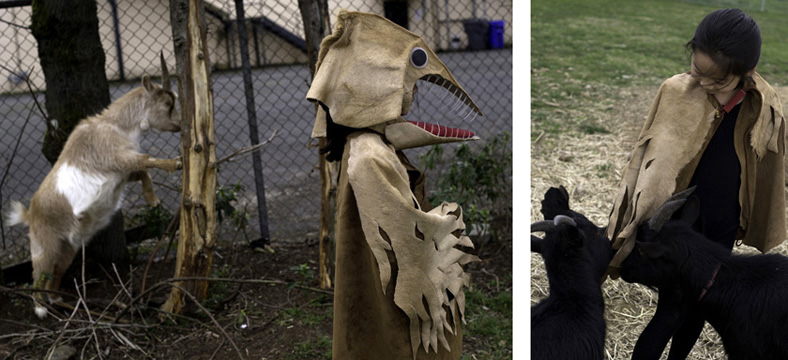
I hadn’t expected to take Experimental Fashion, was not even aware that the course was available. When I heard Lauren, Phoneix , and Will discussing the first class, I knew I had to be there.  I was able to register late. Having missed the first class, I did not know what to expect. At the second class-meeting when I learned that the first assignment was to create an outfit that exemplified concepts of camouflage, I knew exactly what I needed to do.

Jennie was game.

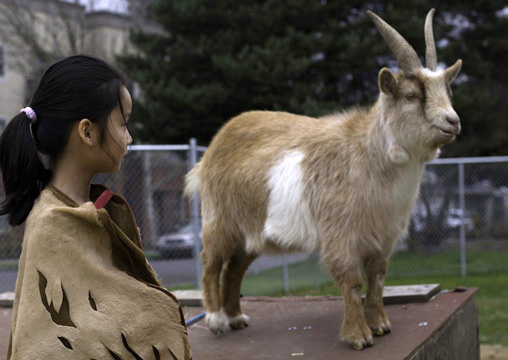
She loved the outdoors and animals, especially goats and sheep, as one would expect of all seven year olds.

I set out immediately in search of material in the scrape bins, counters, tables and shelves at Oregon Leather Co.; like Hamley & Co. years earlier, within walking distance of my home.


In late January, early February I constructed the prototype of a cloak, prescient of themes on display in New York throughout Spring and Fall.*   In the absence of runway, in preference for field and the company of goats, I layered goat hide on pigskin, a match blessed by the Chinese zodiac, sewn with deerskin lace, and linen thread, clasped by bone. This was an outfit destined for assimilation into the lives of animals.

The outfit completed, Jennie and I went in search of a herd of goats.

EyeingEachOther

Cooper was the most curious, he followed Jennie as she moved throughout the enclosed field and into the trees. Atho and his sister Winter came up to chew on her cloak, but after a while lost interest. Others among the herd seemed to take no notice at all.

Jennie_Goats

Jennie was relieved to finally remove her headpiece; only then was she comfortable with the herd.

Jennie_Cooper

In retrospect, the photographic images seem more eventful than the actual encounters.

Next time perhaps we should bring food.

*Sunday Styles, New York Times, September 27, 2015. Last winter I began to follow fashion in the New York Times. I love the insightful writing of Vanessa Friedman, but oddly enough also find myself contemplating fashion ads. The full page Ralph Lauren ad on p. 5 brought back images of early childhood, layered with meaning that captures longings for the pastoral and the imagined cultures of Native America; semblances of elegant primitivism; leather belt and shoes, cashmere sweeter layered above a long cashmere skirt underneath a sumptuous shearling collar that extends from waist to broad brim hat. Fur pelts lie on the surrounding benches; a Siberian husky, indistinguishable from wolf sits awaiting command directly in front, another lies at the models feet; massive antlers stand on floor in line with the partially bark stripped poles projecting upward to the peak of an imaginary tepee.   The coordinated creative efforts by fashion designers, fabricators, animal trainers, photographers, set designers, on this imaginary world of desire personifies our western culture of acquisition and appropriation.

Earlier in the year Vanessa Friedman wrote of “… Canadian fox minifrocks and feral coats pieced together like the earth as seen from above.” In the words of Raf Simons of Christian Dior, this is the “ … the terrain of the ‘femme animal’” ; a “new kind of camouflage”.

The sense of ‘new’ is only in the sensorial migration from the wild landscape of the west to the fabrication of the runway; the image of George Carlin’s, painting, Buffalo Hunt under the Wolf-skin Mask from the 1830’s flashes through my mind.

There is no edge to the imagination.