I am perplexed by the categorization of written works as fiction or non-fiction. I find it impossible to make clean distinction. Virtually all fiction contains elements of non-fiction, and virtually all works claimed as non-fiction contain information that is simply wrong, often times because of the natural nebulosity of information rather than because of author’s intentions.
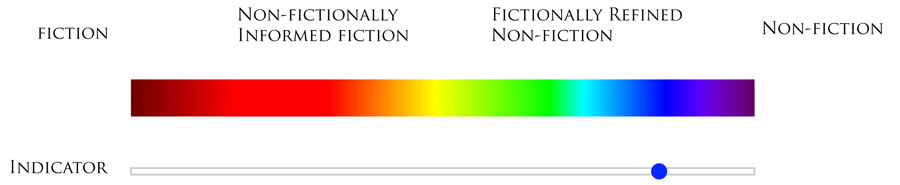
I’m interested in yet another kind of non-fiction, work that is mostly true, but purposely manipulated for artistic effect. In my own work, to improve the flow of language and ideas, I may alter original statements and the order in which these statements were made, but I try to remain as faithful as possible to the original context and meaning. I call the resulting writing fictionally refined non-fiction. For the fun of it I created a graphic (Figure above) that expands literature into an infinite number of categories, with all works located somewhere on a continuum spanning fiction, non-fictionally informed fiction, fictionally refined non-fiction, and non-fiction. Non-fictionally informed fiction includes works that are intentionally fiction, but contain elements of setting and event that recognizably exist or existed.
In the absence of author(s), the position of a work on the scale is guided by the consensus of knowledgeable authority, which may change over time. For example, scientific papers, when first published, would be expected to fall on the far right side of the scale (non-fiction). But as years pass and new discoveries are made, scientific reports frequently slide towards fiction.
Posts on the Against Edges blog will typically fall on the scale between 50 and 95% non-fiction. Examples of ways that I fictionally refine non-fiction can be found in the September 19 posting in which I imagine the thoughts of a young girl climbing a tree. This posting leans towards fiction since the thoughts are imaginary. The 90˚ Solution posting on September 22 is almost entirely factual, but I may not have recorded the original question, “Evie, would you like to take a bath?” with perfect accuracy.
 AgainstEdges